
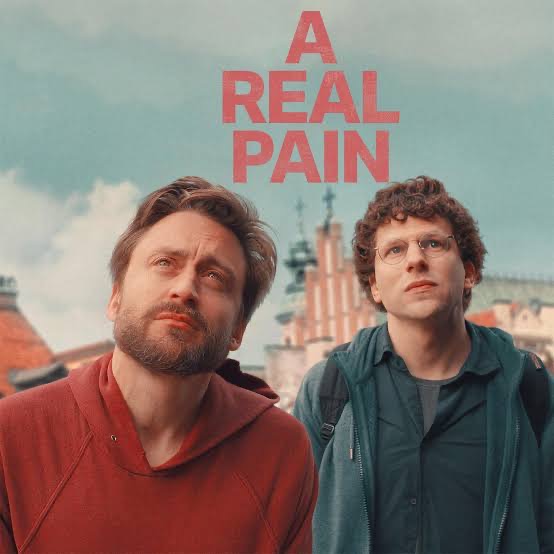
I just saw A Real Pain and it was good. It’s a Holocaust dramedy about New York cousins played by Kieran Culkin and Jesse Eisenberg (also the writer/director) who go on a Jewish heritage tour in Poland to honour their late grandmother.
It’s a funny, moving, and refreshingly compact film, reminiscent of Woody Allen for its gentle music, travelogue direction, and economic storytelling, though much less self-absorbed (and occasionally gross) than anything by Allen. The central conflict is that Culkin is regarded as a likeable if eccentric free spirit while Eisenberg is career and appearances-focused, a seller of digital ads with a beautiful wife and children at home in his brownstone.
Part of the experience of the film for me was figuring out how I felt about the Culkin character. There were times when he came across in my view less as charming (which is how the film mostly presents him) and more a passive-aggressive creep, the type of pseudo-”nice” guy who feels connected to a deeper emotional reality and love bombs you, but in the end all you see is his constant need to monopolise and make the situation about managing his moods.
If he and the Eisenberg character were lovers rather than cousins, his behaviour would be better understood as emotional abuse. I don’t know, maybe I’m the type of uptight square that films and characters like this rail against, but if I were on that tour I’d be very annoyed that my deeply personal (and expensive) experience is being taken over by this person who doesn’t understand that you don’t talk over people and cause unpleasant scenes in railway carriages.
This is largely my problem with the tropes of American “indie” or just inspirational movies in general. The story of the uptight square who’s taught to loosen up by some manic pixie or dope-smoking sprite.
A Real Pain’s craft is insidious, however, in the way that it encourages you to see Culkin’s character from the perspective of Eisenberg’s, the square. This weird oversensitive cousin is uncouth and embarrassing, but over time you realise that yes, he IS oversensitive, and that’s the issue. He’s damaged and troubled and means well, he’s just been less able to force himself through the perspective filter that most of us manage to and which allows us to be functional in this brutalist, brutalising world.
The film’s title is thoughtful and apposite in respect to its application to the cousins’ relationship and the larger context of the Holocaust. What is a “real” pain? Does the aimlessness and hopelessness of a modern New York Jew reflect anything when compared to the horror that his ancestors suffered? Do we have a right to despair when we lead such privileged lives, or is that despair a natural result of the past’s injustices? Possibly the film’s most powerful scene is its tour of a concentration camp, which has relatively little dialogue or music (if any in the latter case) and shows you in static, midday compositions the relics of genocide.
Rating: 3/4
 I Just Saw
Leave a comment