
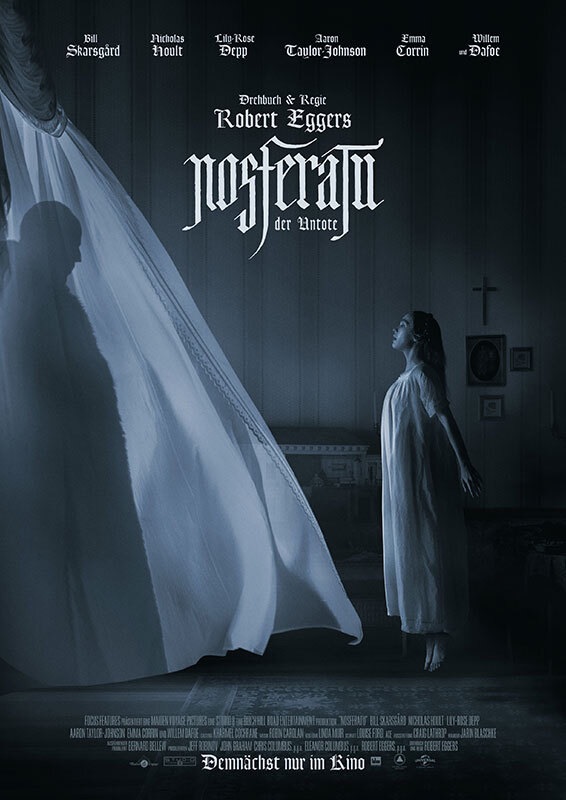
I just saw Robert Eggers’ Nosferatu and it was stupid crap. I was going to be kind and call it a mixed bag, but by the end of the film I had no impulse to be kind. It’s intriguing in its premise in that it’s based not so much on Bram Stoker’s original novel as the 1922 silent film Nosferatu, which was only called that because the makers couldn’t get the rights to Dracula from Stoker’s widow, so instead they changed the names and moved the setting from England to Germany. In this version, then, the hardy young lawyer Jonathan Harker becomes Thomas Hutter (Nicholas Hoult), his wife Mina is now Ellen (an abominable Lily-Rose Depp), while their friends Lord Holmwood and his doomed fiancée Lucy Westenra are Mr and Mrs Harding, played respectively by Aaron Taylor-Johnson (bad but probably doing his best with what he was given) and Emma Corrin (great, considering). Dracula is Count Orlok (Bill Skarsgård) and Van Helsing’s name has been changed to Von Franz (Willem Defoe, the best thing in the film).
I’ll start my autopsy with a positive: a lot of the basic shots were good. I started out liking the movie for its historical detail, with gloomy Dickensian streets, evocative period finery, fashions (Mrs Hardings’ hair and that of her daughters is in those absurd side curls that look like spaniels’ ears), and evenings by firelight. It’s clearly inspired by the silent movie aesthetic.
Unfortunately, as soon as Hutter leaves the peasant lodgings and reaches the perimeter forest of Castle Orlok on his journey to handle the Count’s legal affairs, the film goes off a cliff. Where to begin? I guess the biggest problem is that Nosferatu has no personality. This is easily the worst interpretation of the Dracula character I’ve seen, simply because it’s barely an interpretation. Skarsgård is fine, giving one of the film’s better performances, although it might be hard to judge fairly given that his every utterance is drowned by apocalyptic gravelling on the soundtrack.
The point of Dracula is that he’s subtle, a good host, one who seems at least within the ken of acceptable “foreign” behaviour when Harker meets him. All of the intimacy and slow seduction are gone from this version. In a completely inexplicable decision, Eggers elects to condense the whole meat of Stoker’s first act – the bit of the story that everyone remembers – down to almost nothing. No Dracula crawling down the wall, no Wyrd Sisters, no “music of the night” or kidnapped gypsy child… nothing. Hutter has barely arrived before he’s making his escape. Orlok is barely above the level of an animal and seems subnormally intelligent for most of the piece. (The end of the film makes him seem, frankly, stupid, but I can’t get into that without spoilers.)
Hoult is fine as Hutter, he doesn’t embarrass himself, as hard as the script tries to make him. Lily Rose-Depp, however… she’s not quite as bad as, say, Keanu Reeves trying to do an English accent in Bram Stoker’s Dracula (1992), but she can’t pull off whatever she’s trying to here. Her line delivery is frequently cringe-inducing, not a line of it resonating. It’s pure “amateur dramatics society goes Victorian” and highlights her status as a nepo baby, since on acting alone she would have been relegated to Corrin’s role. Corrin is by far the better actor and could have done something with Ellen even if they couldn’t have saved the character.
Part of the charm of the original text is that the protagonists seem to genuinely like each other. They’re normal Victorians besieged by unspeakable horror but who rise to the challenges posed. In this version, they’re at such obnoxious variance with one another that in a scene that pretty much kills what care you could have had for them, Harding casts both Hutters – Thomas Hutter having been his best friend, mind – out into the cold and plague-ridden, rat-filled streets while Thomas is so unwell he’s barely ambulatory.
The most entertaining part of Nosferatu 2024 is Defoe as Von Franz. The film lights up and becomes an entertaining occult story whenever he’s on screen and allowed to dominate the scene. Defoe has the language and mannerisms down, feeling authentic where others falter.
The Dracula story has always been partly metaphorical for sexual desire and violence, with the Count representing unchecked hedonism and predation. Here Orlok is too mindless to carry such weight symbolically, but elsewhere Eggers is so absurdly unsubtle that by the seventh or eighth time Rose-Depp was thrashing about with eyes rolled up into her head, screaming how Orlok would come inside her, I wanted to walk out before I cringed myself into a stroke.
The film felt three hours long, was punctuated with cheap jump scares, and seemed like it was written by a callow, edgy teenager who hasn’t yet come to terms with his thoughts on the opposite sex. How it was written and directed by the man behind The Witch (2015) and The Lighthouse (2019), two of my favourite folk horror films, is beyond me.
Rating: 1.5/4
 I Just Saw
Leave a comment