
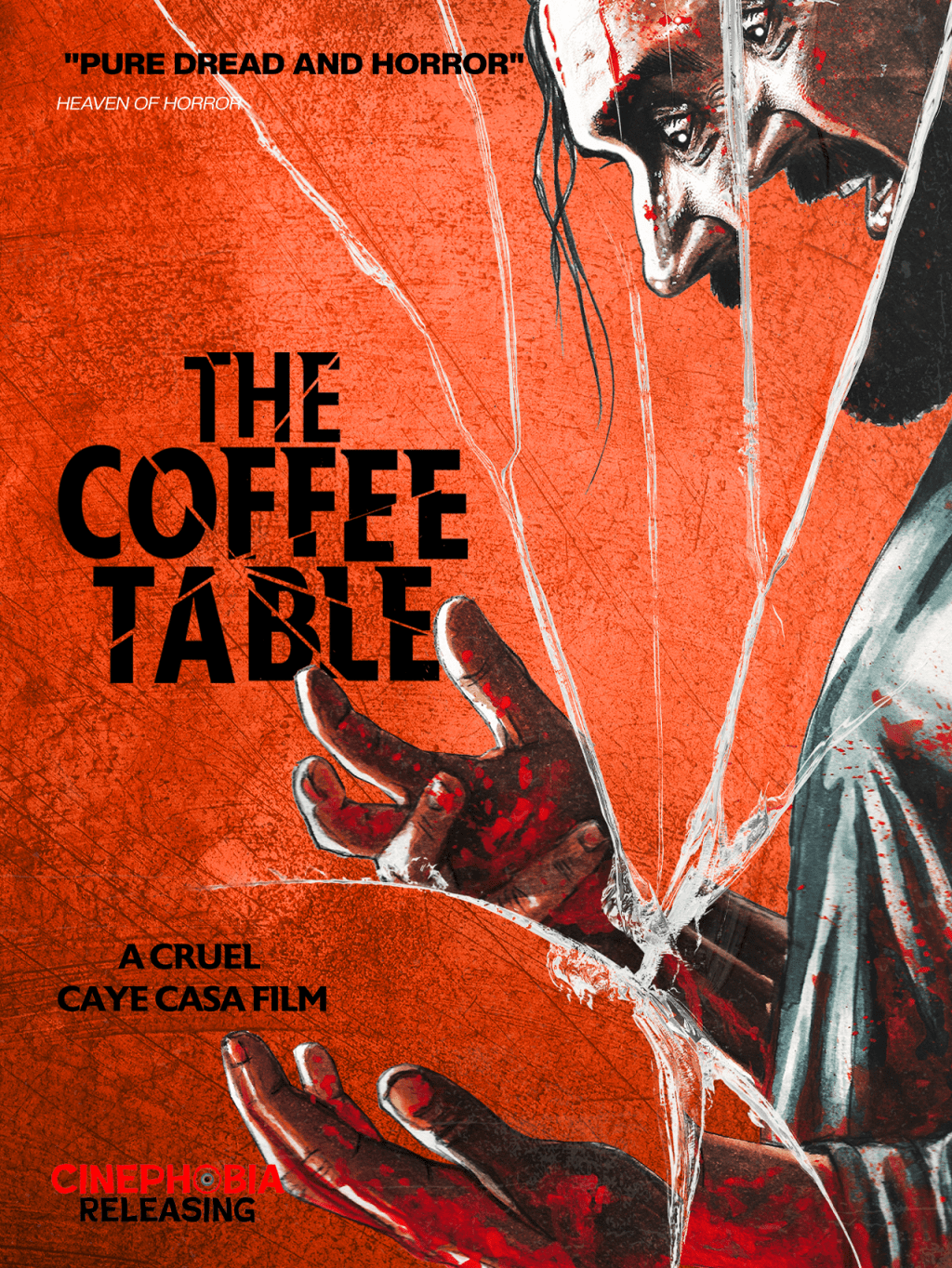
A husband, Jesus (pronounced Hey-Zeus, played by David Pareja), and wife, Maria (Estefanía de los Santos), with their newborn baby, are looking to buy a coffee table. The table is composed of two nude women in faux-gold trim supporting a glass top.
Clearly, it belongs in a bachelor pad as opposed to a young couple’s front room, and the wife makes clear her distaste for it. She’s unpleasant and controlling, he’s frankly a bit dim and probably better suited to eternal singledom (or a wife who wouldn’t mind viewing him essentially as another child to manage).
Nonetheless, he gets his way. Right up until his wife leaves him with the baby and the disassembled table to buy something for lunch, and an unthinkable accident occurs…
I looked up and watched this subtitled Spanish-language film on Shudder after seeing it reviewed on Red Letter Media’s YouTube channel, on which it’s described as having an inciting incident that’s truly, outrageously vile. That’s certainly true.
While I’m not exactly sure what happens with the coffee table, the results are painfully clear and infused with a dark irony concerning the salesman’s claim that its glass is “unbreakable”. From here the film proceeds basically as an extended game of “what would you do if…”
I’m not as enamoured of The Coffee Table as others. (Stephen King raved about it on X, while /Film gave it a perfect score of 10/10. Its Rotten Tomatoes score is 86%.) It’s definitely worth watching if you enjoy outre horror premises and some things are good about it.
The four main characters, Jesus and Maria and another couple who show up for lunch are well-characterised and strongly performed. They feel like real people, and their actions proceed from whom we perceive them to be, adding tension to the plot as it takes on a horrible verisimilitude.
The premise, however, as distinctively cruel as it is, is better suited to a short than a feature, requiring a lot of drawn-out and repetitive scenes after a certain point. Its weakest elements, though, are oddly its most comedic, given that it’s marketed as a black comedy.
Its “comedy” scenes often come across as merely puzzling and fatuous, and misguided in the extreme. There’s an inexplicable subplot about a 13-year-old neighbour girl who’s infatuated with Jesus and threatens to tell his wife about an affair she thinks they’re having.
I have no idea why the girl needed to be 13. The only thing I can think is that since up until 2013 the age of consent in Spain was 13 (it’s since been set at 16), her age is a piece of culturally specific humour that I don’t get.
It still feels like something you’d see in a bad film from 40 years ago, however, before studios realised that sexual interactions between adults and minors aren’t hilarious. Also, perhaps this is me being overly woke, but it’s gross to have an underage actress say some of the things that this script requires her to.
On a story level it also just muddles the central thread, which should be focused morally on the dead baby in the room. Not weird tangents about whether or not the father is a child molester.
Similarly, a scene with the salesman who sold Jesus the coffee table starts well with a lot of Hitchcock-style tension but then degenerates into a weird “comedy” bit where it seems like the balding, fiftysomething (judging by appearance) salesman is trying to have sex with him. The joke being… search me.
I genuinely don’t know what the scene is trying to communicate. That the salesman has marked his customer as so dim and pliable that he can exploit him for sex? Haha?
Again, maybe I’m just out of step with the state of comedy in Spain. The film works well for the first 45 or so minutes, which is probably how long it should have been, and the ending is very good, a hard and inevitable twist. The best part of The Coffee Table is its probing illustration of that horrible question: what on earth would YOU do in this situation?
Rating: 2.5/4
 I Just Saw
Leave a comment