
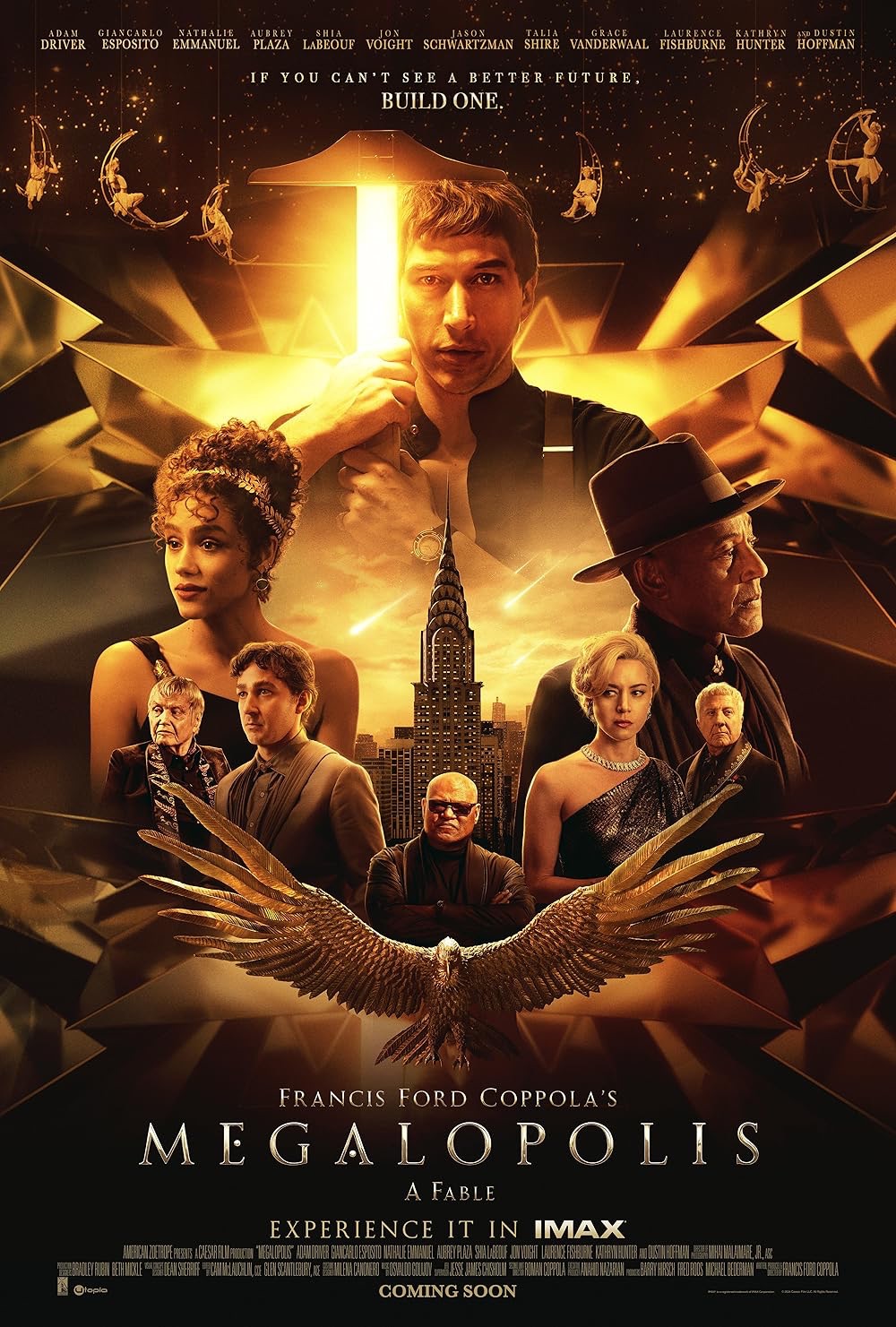
I just saw Megalopolis and although it’s not cool to say so, I enjoyed it. It’s an eccentric satirical and symbolic piece filled with characters with names like Wow Platinum (Aubrey Plaza), and inspired by the Catilinarian conspiracy of Ancient Rome. Set in the city of New Rome (New York in our world, retaining the icons of that place, like the Chrysler Building and Central Park), it follows an architect called Cesar Catilina (Adam Driver) who’s discovered a miracle substance called Megalon that he plans to use to build Megalopolis, a utopian society regarded with suspicion by the philistines in government.
Developed incrementally over four decades, Godfather maestro Francis Ford Coppola’s vision is fantastic and it’s sad that critics especially have been so hostile to it. Not that anyone needs to like it, but it’s such a visionary and literate film that you’d think it would be appreciated for those qualities, at least. Anything strange and rich in personality, even if a failure, should be regarded as a precious rarity in this age of boilerplate corporate crap.
To address some specific criticisms made, I’ve heard it said that the film doesn’t have a plot until the last 10 minutes when two characters hatch a plan to take over the bank of New Rome. This just isn’t true. Yes, those characters only devise that precise plan near the end, but it’s the natural endpoint of their machinations throughout the story, which is taken up with the various indiscretions and schemes of the upper social strata of New Rome as Cesar tries to sell them on his utopian vision.
It’s been said that the plot at large is incomprehensible which, again, no it isn’t. It’s idiosyncratically told, I guess, and the film isn’t just about its plot. But at a narrative level, it’s easy to comprehend. Cesar Catilina is a genius architect using a miracle substance that expands and rebuilds structures, called Megalon, to design a new city that will improve the quality of life for all of New Rome’s citizens, but Mayor Cicero (Giancarlo Esposito) clings to tradition and is deeply suspicious of utopian thinking. Meanwhile, his daughter Julia (Nathalie Emmanuel) becomes Cesar’s protege and eventually his lover.
There are subplots and all sorts of narrative cul-de-sacs including Cesar’s wrongful arrest for his ex-wife’s murder, an attempt to defame him for deflowering a vestal virgin, and so on, but at a base level, it’s not more convoluted than what I’ve described.
Another specific criticism I’ve seen is of the dialogue, which Mark Kermode said was filled with unspeakable lines that should have stayed unspoken. Driver’s quoting of Hamlet’s “To be or not to be…” speech has come in for a kicking as pretentious and unmotivated, which, and I’m sorry to repeat myself yet again, but… no, it isn’t. It takes place at a televised city planning conference where Cesar is arguing for his vision of Megalopolis, and asking if his audience thinks it’s better to address the city’s problems by letting it die. Since the Shakespeare monologue is about suicide, it makes sense with the theme.
Cesar also has a line later on that’s come in for derision: “There are two things you cannot look at for too long without going blind: the sun, and your own soul.” (Probably slightly paraphrased.) Like the monologue, though, it makes sense in context. He’s addressing someone who’s just revealed a major, shameful indiscretion unbecoming of their office. I feel like in any other movie no one would care about that line, but for some reason, a lot of people seem to have it in for Coppola over this film, the reasons for which are complex.
I don’t say all of this as a Coppola fan. I’m not a fan, really. I like some of his films, my favourite being Apocalypse Now, but I’ve seen far from all of them and find him as a person to be pretty detestable for his alleged role in the traumatisation of Nathan Forrest Winters, a 12-year-old in the late ‘80s who was molested by Coppola’s friend/mentee Victor Salva (who’d go on to be known for the Jeepers Creepers films).
According to Winters, Coppola took over production of the film that Winters was starring in under Salva’s direction (1989’s Clownhouse, shot partially at Coppola’s home and funded by him) when the abuse was revealed, and berated the child about how he’d never work in Hollywood again while demanding he come in to complete vocal elements.
Coppola would go on to try to ameliorate Salva’s culpability by saying that it was a mistake and that Salva had been young too. Hopefully, he didn’t know at least when he made that remark that Winters was seven when the abuse started, and Salva in his late twenties.
So, yeah, this isn’t about polishing Coppola’s knobs or whatever. Artists are flawed human beings, just like plumbers and doctors and hairdressers are, go figure. Accusations have been made of inappropriate behaviour on the set of Megalopolis, though at least one actress has refuted this and hit out at the magazine Variety for publishing video taken from a closed set supposedly to prove Coppola’s misconduct (having watched these videos that show Coppola from behind, I can say that they’re not proof of anything, in my opinion), since Variety’s publication of this material represents a violation of her privacy.
At any rate, it seems as though the critical establishment has in large swathes had it out for Megalopolis. The only thing that sets it apart from the director’s other recent films is the budget and funding, handled by Coppola himself by selling his wineries. Otherwise, he’s been making this sort of strange, symbolic genre fare for well over a decade, including the fantasy romance Youth Without Youth (2007) and horror film Twixt (2011). The nature of time and consciousness has been his predominant theme, combining plots with elements of romance and mystery with abstract arthouse content, more concerned with symbols than simply narrative.
Whatever you think of Megalopolis, it’s a beautiful movie to look at. It’s arguably “pure cinema”, an avant-garde movement that interpreted film as its own medium and focused on using its “language” – montage, close-ups, etc – to create emotional experiences unique to the form. I loved the sci-fi magazine aesthetic to the images of Cesar’s ideal city with all its amazing technology, and the sheer idiosyncrasy of Coppola’s symbolic imagery.
I wouldn’t say that Megalopolis is perfect because it isn’t. It could have done with a twenty-minute trim and has a habit of explaining character decisions in the dialogue that’s very tell-don’t-show, such as when Cesar autographs a child’s book and Julia helpfully informs us, ‘Cesar can never say no to a child.’
What I think that I mostly enjoyed was seeing how the tropes of Ancient Rome are applied to the sci-fi setting and characters, the abstract imagery, and the vision of utopia that Coppola sets out, where people can work together despite their differences to create a better world. The acting is good too, with Jon Voight and Shia LeBeouf giving surprisingly amusing performances as Donald/Eric Trump stand-ins, respectively, while Driver brings his usual gravitas to Cesar.
Rating: 3.5/4
 I Just Saw
Leave a comment