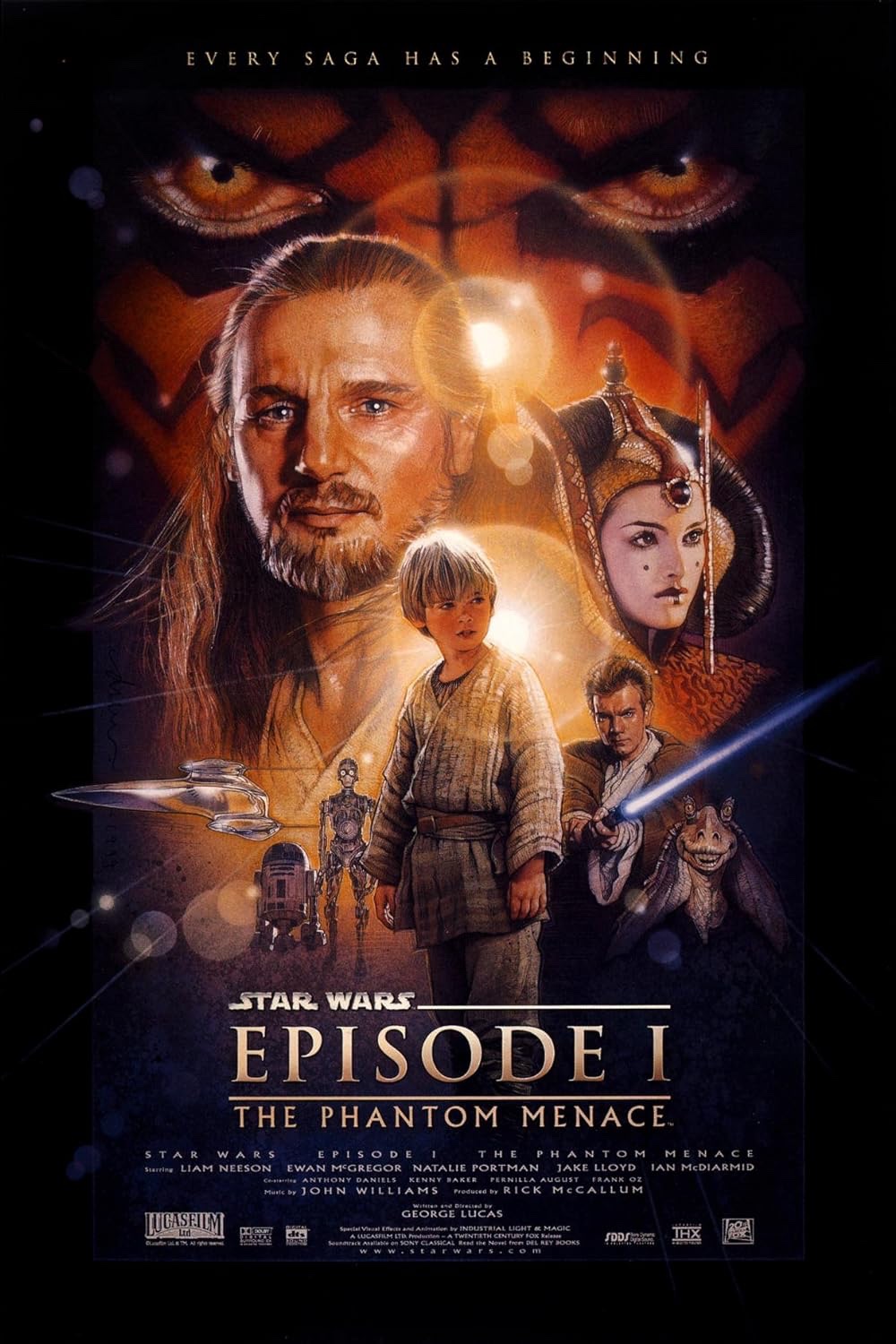
The Star Wars prequels have recently undergone a slight recovery in reputation given how disappointing the sequels turned out to be, and in my opinion, they deserve it. Perhaps I’m buying into a conspiracy theory here, though at this point I feel that the backlash was really just fanboys who watched the original films as children, got angry they weren’t having the same experience they did when they were nine, and then came together in the early days of commercial internet to confect the narrative that the prequels were incompetent hackwork.
The same type of fanboy would later go on to turn Star Wars fandom into a toxic cesspit of overprivileged, hostile brats who somehow managed to politicise a children’s fantasy series while real wars and atrocities are happening. I was going to remark that a section of them are also remarkably racist, sexist, and homophobic, which is true. However, even the ones who aren’t outright bigoted in those obvious ways can be just as awful, and just as destructive to the accessibility of this thing that they allegedly love.
Going back to The Phantom Menace, when it came out it received mixed to positive reviews, much like its immediate predecessor, Return of the Jedi (1983). Roger Ebert and James Berardinelli of ReelViews both gave Menace 3.5/4, while Owen Gleiberman assigned a “B” grade. Criticism was made of the story and characterisation choices, though it seemed to be a consensus that the film was a triumph of audiovisuals.
Seeing it again in the cinema for its 25th anniversary, it’s still a fun and engaging sensory experience. Most of the plot revolves around Jedi master Qui-Gon Jinn (Liam Neeson) and his apprentice Obi-Wan Kenobi (Ewan McGregor), who start out visiting a space station to settle a trade dispute when they’re attacked on command by a mysterious figure in hologram. Meanwhile, the galactic Queen Amidala is being pressured to sign a treaty that will further the career of a certain chancellor. In resolving these issues, the two Jedi meet various strange creatures including Jar-Jar Binks, the titular menace Darth Maul, and a young boy, Anakin Skywalker (Jake Lloyd), whose cellular connection to the Force is such that he might be the one to restore its balance…
The Phantom Menace’s greatest strength is its marriage of image and sound in service of an engaging pulp narrative. Scenes like the pod race are still very exciting to see on a big screen due to both the diegetic (in universe) sounds and musical soundtrack, as well as the scale of the setting and all its little details, like two sports commentators who share a body and an alien vendor selling weird frog-like “snacks”. The climax, meanwhile, is beautifully juggled in its three story strands. I can tell when it’s approaching by the ramping up of music and action, and even on this viewing I got a little of the feeling I did as a kid.
None of this is to say that The Phantom Menace is perfect, far from it. The plot is convoluted in a way that doesn’t suit its genre, being much too concerned with things like taxation and trade routes. You hear more about internecine politics than anyone would ever care to in a children’s science fantasy.
Also, the allusion to Anakin having been the product of immaculate conception (his mother states that he has no biological father) is clumsy and cringeworthy, and the whole slavery angle with the boy and his mother is weird anyway, especially when she says that her place is as a slave. (Can you imagine the optics if they’d cast a Black or even just non-white actress in the role?) I get that Star Wars is religious science-fiction, hence why the outlying planet of Anakin’s birth resembles a sort of space opera Bethlehem, but couldn’t Lucas have found a more elegant means of conveying these themes?
Furthermore, on a plotting level, the film is called The Phantom Menace but the character that’s referring to, Darth Maul, is completely incidental. Even as a child this bothered me. It would be like naming a James Bond film after a random henchman. He looks cool, I guess, and serves the purpose of killing a major character during the climactic lightsaber duel. However, you could replace him with any random alien recruited by the villain and nothing would change. This is where it becomes obvious that Lucas went with his first draft of the script.
Nonetheless, I really like The Phantom Menace. It’s my favourite of the Star Wars prequels because it’s the one that comes closest in tone to the original films, which went for fun serialised adventure on a grand audiovisual scale. Lucas’ biggest mistake with the prequels, I think, was in making them prequels at all. If he’d come up with a whole new set of characters existing far in the future from the original stories he probably would have fared a little better with the fanboys. Plus the nature of prequelising Star Wars is that you’re forced to build up to and end on a downer (Darth Vader becoming… well, Darth Vader).
Enjoyed on an audiovisual level, though, The Phantom Menace is a lot of fun. It has beautiful-looking landscapes, gritty and expansive locales like the underwater city and desert outpost, awesome senatorial buildings, and exciting space as well as land battles. When RedLetterMedia made their famous review of this film they remarked on how unremarkable the characters supposedly were compared to those of the original trilogy. I didn’t get that personally, though.
The original characters are more vividly archetypal, I suppose, but I didn’t have trouble identifying personas here. Qui-Gon is stern and a little too wilful, Obi-Wan is gifted though still somewhat headstrong, Anakin is your standard issue precocious child, and Natalie Portman’s “handmaiden” is honestly the best character, in my opinion. She’s dutiful, subtly playful, kind, and intelligent, and her arc is the most well-developed in the film. The story should have been named for Queen Amidala, honestly. Say, The Soldier Queen, or even The Phantom Queen given the switcheroo with the handmaiden.
To address the issue people had with Jar-Jar Binks, the part rabbit, part reptile-esque biped whose silly and clumsy persona marks him out as comic relief, he’s not anything like as overpresent or annoying as the backlash claims. Again, I have to assume that the fanboys didn’t like seeing a character designed to appeal to children when they’re no longer children themselves because they never learned to appreciate art and media aimed at a mature audience.
So while they’ve grown, their tastes haven’t, and now they’re angry at a kids’ film for not catering to them or providing the same experience as when they were still cognitively limited by childhood. Essentially, they’re mad at Santa Claus for not being real so now they can’t just enjoy Christmas for what it is. To which I can only say: grow up. Or, you know, read a book, watch a documentary, do something to broaden your cultural appreciation.
It saddens me that I have to address the backlash and toxic fandom when reviewing these films, but regardless, having seen it again as an adult, I can confirm that The Phantom Menace is a fun pulp adventure and a brilliant cinematic experience. What George Lucas made here was a movie with a capital M, where you can watch it with the sound off and still follow the plot, dialogue being less important than what you’re seeing. (Lucas has said that a major inspiration was silent film, and compared his use of dialogue to lyrics to a song.) I’d much rather watch this or either of the other prequels to anything from the bland, homogenised, corporate sequel trilogy.
Rating: 3/4
 I Just Saw
Leave a comment