
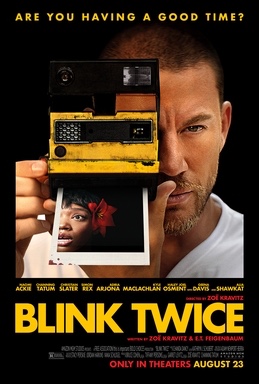
I just saw Blink Twice, the directorial debut of Zoe Kravitz, and it was really good. Besides the certification card, it came with its own “trigger warning”, and I guess I can see why. This is very much a post-MeToo movie, and possibly (?) the first fiction film to tackle the Jeffrey Epstein scandal in so direct a fashion.
Naomi Ackie plays Frida, a waitress at a black tie gala who literally stumbles into a fairy tale encounter with Slater King (Channing Tatum), a tech bro mired in a misogyny scandal who as part of his PR rehab owns an island at which he and his guests dispense with their phones and rediscover their “intentionality”. Dippy rich brat nonsense, basically.
Frida, however, is whisked off her feet when he invites her along. But why are the locals mute and hostile, what’s with the snakes everywhere, why does the facilitator (Geena Davis) keep handing out red bags to male guests, and… wait a minute, did Frida just get on a plane to a remote island and surrender her smartphone for a man she barely knows?
On one level I enjoyed Blink Twice simply as a thriller. It plays a bit like a much darker version of the mystery film Glass Onion (2022), also about an ordinary black woman infiltrating an island of rich friends with sinister secrets. I wouldn’t be surprised if Kravitz had been imbibing some Roald Dahl and Tales of the Unexpected. I think I saw a reference to “Man from the South”, about a gambler in the tropics who collects human fingers, and possibly “Poison”.
The mystery’s resolution is profoundly horrible, as you can imagine from names like Epstein and MeToo being evoked, and Kravitz really doesn’t flinch here. The sexual violence isn’t exploitational, but in one scene where the nature of what’s going on is made explicit, it IS provocative. This bit alone is likely what inspired the extra trigger warning, some executive at MGM or Amazon deciding that it needed to be added for extra protection if the film became too controversial.
One of the things that’s most impressive about Blink Twice is how it adumbrates the various personality types that cluster around organised sexual crime, from the heartless Jeffrey Epstein type to the moral coward who suspects but does nothing, and even the former victim whose survival approach was to repress and become a functionary of the system, luring in others. Although Epstein and Ghislaine Maxwell are the obvious allegory (Epstein is even added to a photograph in a blink-and-you’ll-miss-it-moment), I wonder if Kravitz had Armie Hammer in mind when characterising Slater King.
Hammer is the former Hollywood star born of privilege who witnessed all manner of debauchery in his rarefied circle as a boy, and went on to be revealed as having engaged in or fantasised about various depravities. Some surprisingly subtle work exists in how Kravitz and her co-writer don’t present their villains as one-dimensional slobs and brutes.
Some are damaged, some are so inured to privilege they don’t have a moral intelligence, and others are more Prince Andrew types: idiots, who just don’t question what’s behind all the “gifts” they’re being given, and take them as a matter of course. Did the girl serving lunch look oddly young and scared? Did she seem like she didn’t really want to be there when she came to your room? Oh well, it’s not yours to question.
As heavy as these themes are, Kravitz adds a rich vein of dark humour especially in the second half as the violence ramps up. She juggles it beautifully as well, with some well-observed character moments for the female players. It’s refreshing in a thriller like this to have such vivid characterisation for the women’s roles. Tatum is brutally effective as King and has a moment both sad and horrifying in his final rage against life. He’s a monster, but like a lot of monsters – like Hammer, like Epstein, like Maxwell – he’s also deeply, incurably pathetic.
Rating: 3/4
 I Just Saw
Leave a comment