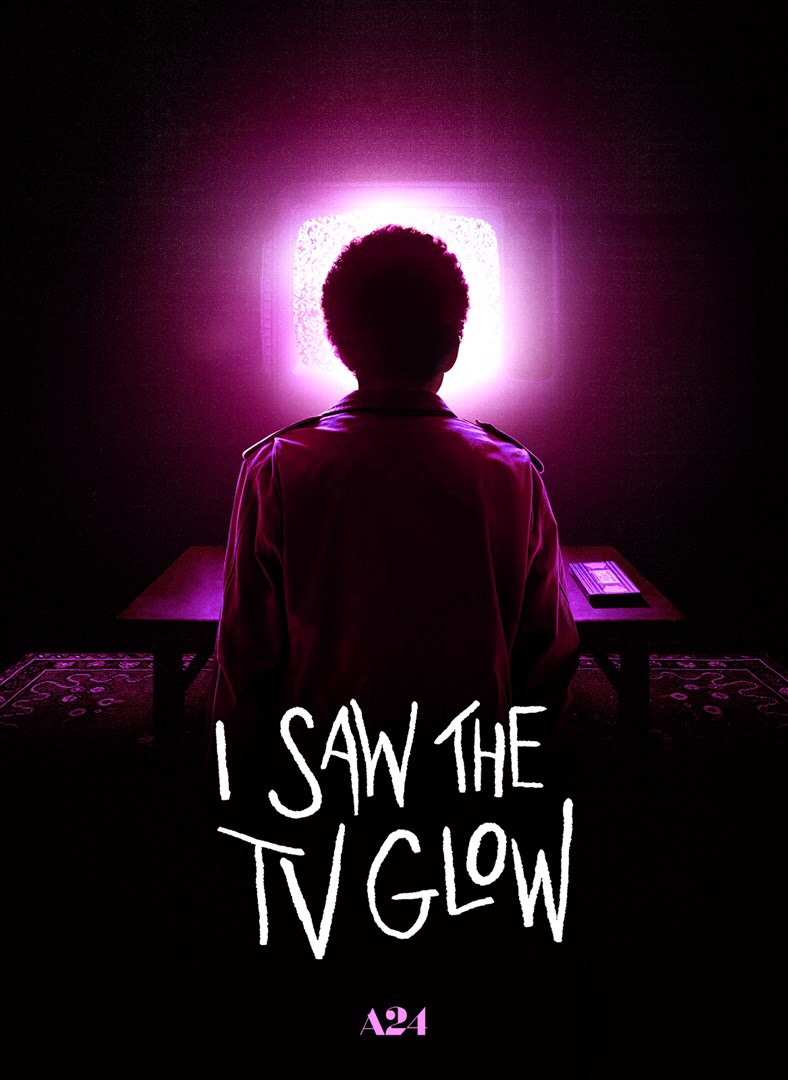
I just saw I Saw the TV Glow and it was honestly fantastic. What starts as a typical if somewhat atmospheric YA drama about disaffected high schoolers in the ‘90s bonding over a television show becomes stranger and spookier until it’s an almost David Lynch-ian mystery, with resonant themes of fear and self-loathing. When I was leaving the cinema I overheard a group of girls who’d been in the screening room discussing it and one of them said, ‘It was a movie… but it wasn’t a movie.’
That I think sums up the general attitude to non-standard narrative in mainstream films, and while I Saw the TV Glow might be a little too disconnected to resonate with even cult audiences beyond a certain level, I was delighted to see something this unapologetically eerie and weird.
It opens in 1996 as Owen Foreman (later played by Justice Smith when he grows into a young man), a seventh-grade student, runs into Maddy (Brigette Lundy-Paine), a ninth-grade goth who gets him into watching a ‘90s YA show a la Buffy the Vampire Slayer, Are You Afraid of the Dark? etcetera. Their show is called The Pink Opaque, about two girls with a psychic connection who take on monsters-of-the-week, sent by a mysterious Big Bad called Mr Melancholy.
Both Owen and Maddy are neglected and troubled by what makes them different. Owen is asexual and possibly neurodivergent, while Maddy is a lesbian. Their bond as outsiders endures until one day Maddy disappears, leaving behind just a burning TV in her parents’ garden.
More than that I won’t say, although this isn’t a movie that gives you answers, and after a point stops being usefully literal at all. The world of the TV show mixes with Owen’s reality until the two become at times indistinguishable. What happened to Maddy is answered in a way, but also not even slightly. It’s a movie, but also not…
When it comes to determining what’s “real” in the story, the anchors are Owen, his mother, and Maddy, as well as the relationships that he has with these women. But Owen’s mother leaves the narrative fairly early on and Maddy’s usefulness in judging reality goes away completely the moment she disappears. After that, whatever influence she has on the story might just be Owen’s imagination. Lundy-Paine gets a monologue at one point that’s both chilling and heartbreaking.
The film could be interpreted as being about the loneliness of neurodivergence, how a young man latches onto a show that gives him an escape route from his mundane destiny of living in a world that he doesn’t understand, and that doesn’t care to understand him. A thick layer of sadness pervades the narrative, reinforced by its ambient lighting from glowing TV sets, arcade machines, etcetera. The show and Maddy offer him an answer to why he feels so disconnected, but he dismisses it as just fantasy, kids’ stuff.
Whether or not you believe the fantasy or decide that all of what happens after Maddy’s disappearance is just the fevered imaginings of a sad man might say something about you. Or not. This is a movie that depends on interpretation. It might be this generation’s Donnie Darko (2001), another film about a disconnected suburban teen who might be connected to some vast supernatural mosaic of inner meaning, or just lonely and mentally ill.
The movie’s supernatural imagery is haunting regardless of whether it’s supposed to be real, an extended sequence of a moon-shaped fiend tormenting a young woman especially chilling. It also captures the feeling of being young and how television shows can seem the whole world to you. As strange as the story gets, there’s a buried emotional thread about sadness and isolation and failure, what it’s like to be young and then suddenly old, that runs deep throughout.
Rating: 3/4
 I Just Saw
Leave a comment