
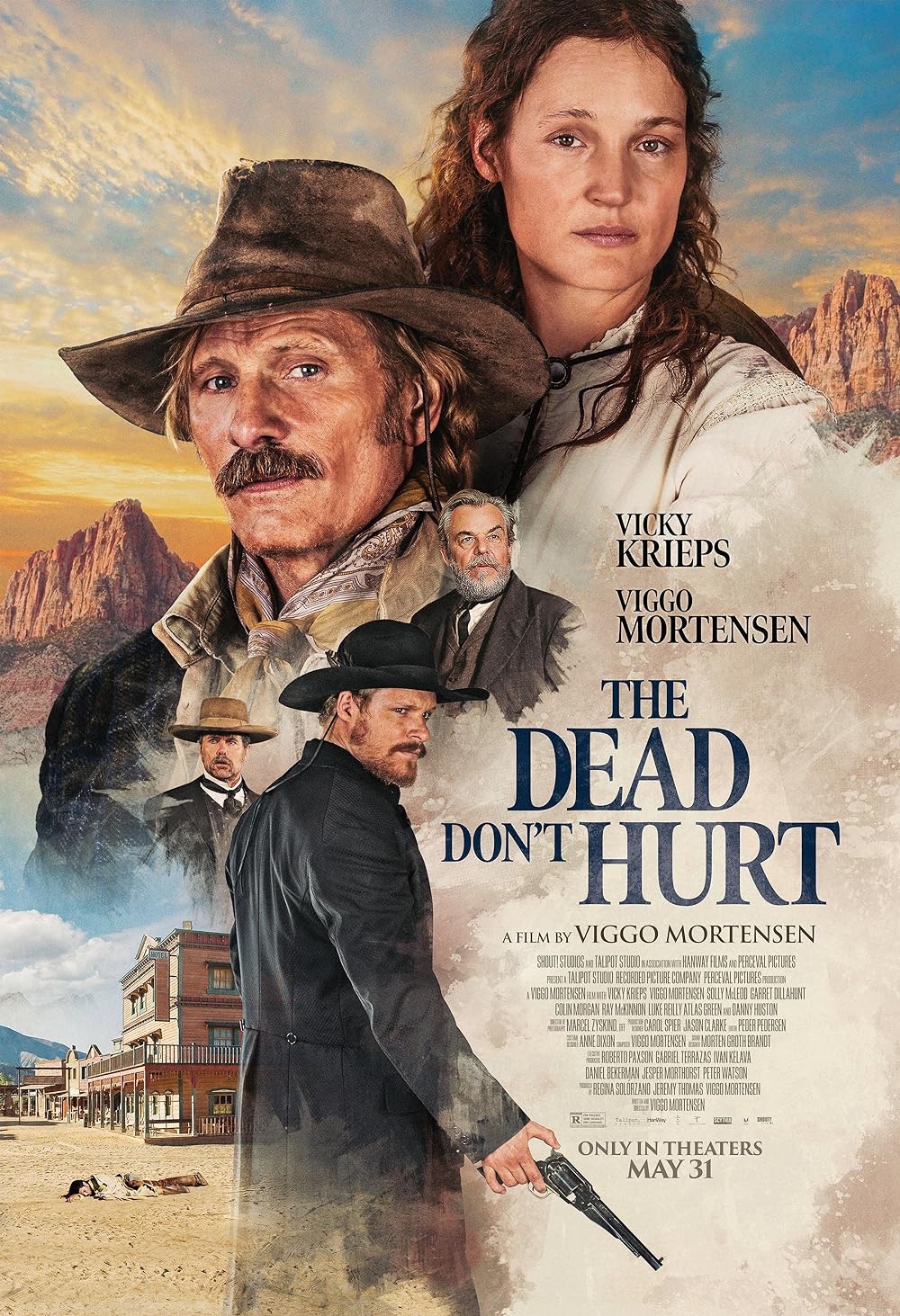
I just saw The Dead Don’t Hurt, a western written, directed, composed by, and starring Viggo Mortensen, and it was the dullest, most poorly constructed piece of loose grouting that I’ve seen in a cinema for… a while. 0/4. I rarely give a film a zero score because my rule normally is that if I can get through it in one sitting without pauses due to the quality, it’s worth half a star, however bad. I gave The Exorcist: Believer 0.5, and that one made a travesty of my favourite movie. I gave The Strangers: Chapter 1 a 0.5, and that’s a film where nothing happens. I’m going rogue here for a couple of reasons, one being that I would have walked out if I hadn’t had a mate with me, although to be fair I said that about Believer.
There were a lot of walkouts in my screening of The Dead Don’t Hurt, which was a special mystery screening for cinema cardholders. Two young lads walked out in about 5 minutes, perhaps anticipating that they wouldn’t enjoy what seemed to be a slow-moving, artsy western. At any rate, those boys were prescient, and I salute them. The cinema’s social media is getting piles of negative comments about this movie, and I’m right there with them. That 83% of 30 critics polled on Rotten Tomatoes is proof enough for me that the critical establishment has confused “pretentious” and “confusing” with “artful” and “difficult”.
I normally defend critics and am probably guilty of dismissing popular taste in quite a snobbish way. Here, though, I genuinely don’t understand how professional critics can look at this incoherent script with its mediocre direction and monotone score and limp, unfinished characterisation and conclude as the Tomato meter does: “A solid step forward for Viggo Mortensen as a director, The Dead Don’t Hurt offers viewers a comfortably old-fashioned Western with a satisfying, character-driven story.” That’s insane. And an insult to old-fashioned Westerns. Watch True Grit (either version). Watch Unforgiven. Watch The Quick and the Dead, even. They’re all incalculably better dramatic works on the level of basic craft alone.
The plot of The Dead Don’t Hurt charts a romance between Danish immigrant Holger Olsen (Mortensen), who in the 1860s is the sheriff of a small saloon town, and Franco-Canadian flower seller Vivienne Le Coudy (Vicky Krieps). The town is run by corrupt landowner Alfred Jeffries (Garret Dillahunt) and his son Weston (Solly McLeod), whose paths will violently intersect with the couple’s.
This story’s basic elements are as old as the genre itself. Rich man and his psychotic son run a small town ragged, the sheriff’s wife is assaulted by the son, and so the sheriff takes revenge. This basic plot has been used in millions of books, films, and TV shows. Yet Mortensen somehow manages to so poorly communicate it that I spent most of the film not understanding what happened to various characters, why some seem to reappear after they’ve been killed, why certain decisions are made, who some people even are, and so on.
The problem is that Mortensen has decided to tell this story in a non-linear style, and hoo boy, he is NOT Quentin Tarantino. By chopping up events he so badly confuses things that you have to reverse-engineer the plot to make it make sense. He starts with a dying woman, a burial, and a shootout at a saloon followed by an unjust trial that leads to an innocent nonverbal man being hung. (Who later shows up in a saloon, just dandy. Search me.) Fine. We expect this to be the plot of the film from here on out.
However, the script then follows Sheriff Olsen as he seems to travel to San Francisco to conduct an inane affair with an inane Frenchwoman, Vivienne, who’s independently spirited for her time. Meanwhile, the son that we see he has and the daughter we see that she has (in parallel scenes where they were together before what I thought was Vivienne’s husband left) completely disappear.
The woman’s daughter appears periodically but only in semi-fantasy scenes afterwards, where she interacts with a knight on horseback in the woods. Again, search me. (Based on context, the knight is probably actually Joan of Arc, if that helps?) Looking back, I think I know who the daughter and her parents whom we see actually were, and by rearranging events, I can work out why the sheriff’s son seems to disappear, but I can hardly enjoy a plot that I’m still struggling to grasp once the film is over.
And this isn’t a David Lynch film where that’s the point. At a really, really basic level of shot composition and arrangement of scenes, it just doesn’t work. There’s no communication between past and present to guide you in parsing the two. Based on how the story was presented, at one point it seems like the sheriff took his maybe 5-year-old son to fight the Civil War with him, leaving me to assume that the poor kid’s buried in a Yankee grave somewhere when he disappears from the narrative and no one mentions him.
I’m sorry, but you really have to hold that 83% of critics’ feet to the fire here. I’ve not seen a clearer case of the emperor having no clothes since I don’t know when. It’s almost on a par with an art prank that occurred some years ago in the UK, where an elephant’s random daubings were passed off as intentional painting, and oblivious critics fawned over it.
Even without the terrible craftsmanship, the film is just plain bad. Vivienne is a shallow piece of characterisation who only exists to be feisty for her time and then pay the ultimate price for it. Mortensen’s Holger Olsen traipses about in a Rod Stewart ‘do and ‘70s gay porn moustache trying and failing to give his own writing personality. Dillahunt gives the best performance as a property developer who would fit right into a better film, maybe even have some complexity, a la Gene Hackman in Unforgiven. British actor Solly McLeod scowls a lot and gives the film more effort than it deserves. Otherwise, though, the dead don’t hurt, but I did while watching it.
Rating: 0/4
 I Just Saw
Leave a comment