
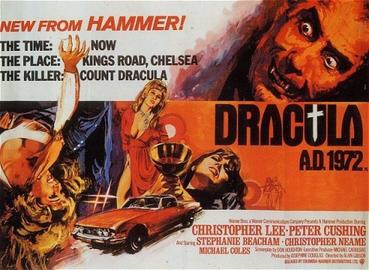
Dracula AD 1972 is one of the not fondly remembered Hammer films to star Christopher Lee as the eternal bloodsucker, the penultimate entry before The Satanic Rites of Dracula (1973) finally stuck a stake in the franchise’s heart. When AD came out it was widely panned and it seems to have retained its dire reception among critics. It was definitely an attempt to haul the ancient formula abreast of the 1970s, when teenagers and young people were giving grief to their elders in the wake of the sexual revolution.
After a cold open where Dracula (Lee) and Van Helsing (Peter Cushing) die fighting one another in 1872, and a mysterious man collects the Count’s ashes, we cut to a hundred years later in Chelsea. Cushing plays Van Helsing’s grandson, an occult scholar whose granddaughter (Stephanie Beacham) runs with what used to be called a “fast set”. Their gang is led by Johnny Alucard (Christopher Neame), who suggests that their next bit of fun should be a black mass at a church where one Van Helsing and his nemesis are buried…
Stanley Kubrick’s A Clockwork Orange (1971) was clearly an influence on the aesthetic here, with star Neame resembling Malcolm McDowell as Alex DeLarge, right down to the top hat, hangout (a coffee bar/drug den as opposed to Alex’s milk shop), and smouldering intensity. The story proper opens at a party in a townhouse where girls dance on tables to live music (from the real-life band Stonegarden) and elderly people look horrified. The theme reflects contemporary generational tensions and plays them for light humour.
Critics at the time were dismissive of the film as a shadow of Hammer’s prior successes and a generally shoddy bit of hack work. Roger Ebert gave it 1 star and it has a 27% rating on Rotten Tomatoes, with a surprisingly low audience score at 40% to boot. It’s really not bad if you go in knowing what it is, though.
Okay, so the plotting is ropey and often ridiculous. (I saw the film at my local art centre’s Classic Horror Nights, and the audience howled with laughter when Cushing drew a diagram of Alucard’s name to reveal how it reads backwards, as if working that out is an example of his genius.) In the tradition of trashy horror films, the “teenage” cast are all in their early to late 20s and look it, and none of them are especially charismatic here.
But it moves at a snappy pace, is never dull, and perhaps most importantly, enough time has passed that its contemporaneous elements feel charming rather than cheap. This is an extremely ‘70s film, right down to a black mass performed to the strains of a tape recorder. Not to mention the greasy hair and thumping disco music, with a hard bass line consistently used to amp up suspense. The soundtrack is one of the best things about the film.
Its biggest flaw is that it has far too little of Lee. When he finally gets to deliver a great, booming line to Cushing in the climax, it dwarfs all else. Still, 1972 wasn’t such a bad year for vampires.
Rating: 3/4
 I Just Saw
Leave a comment