
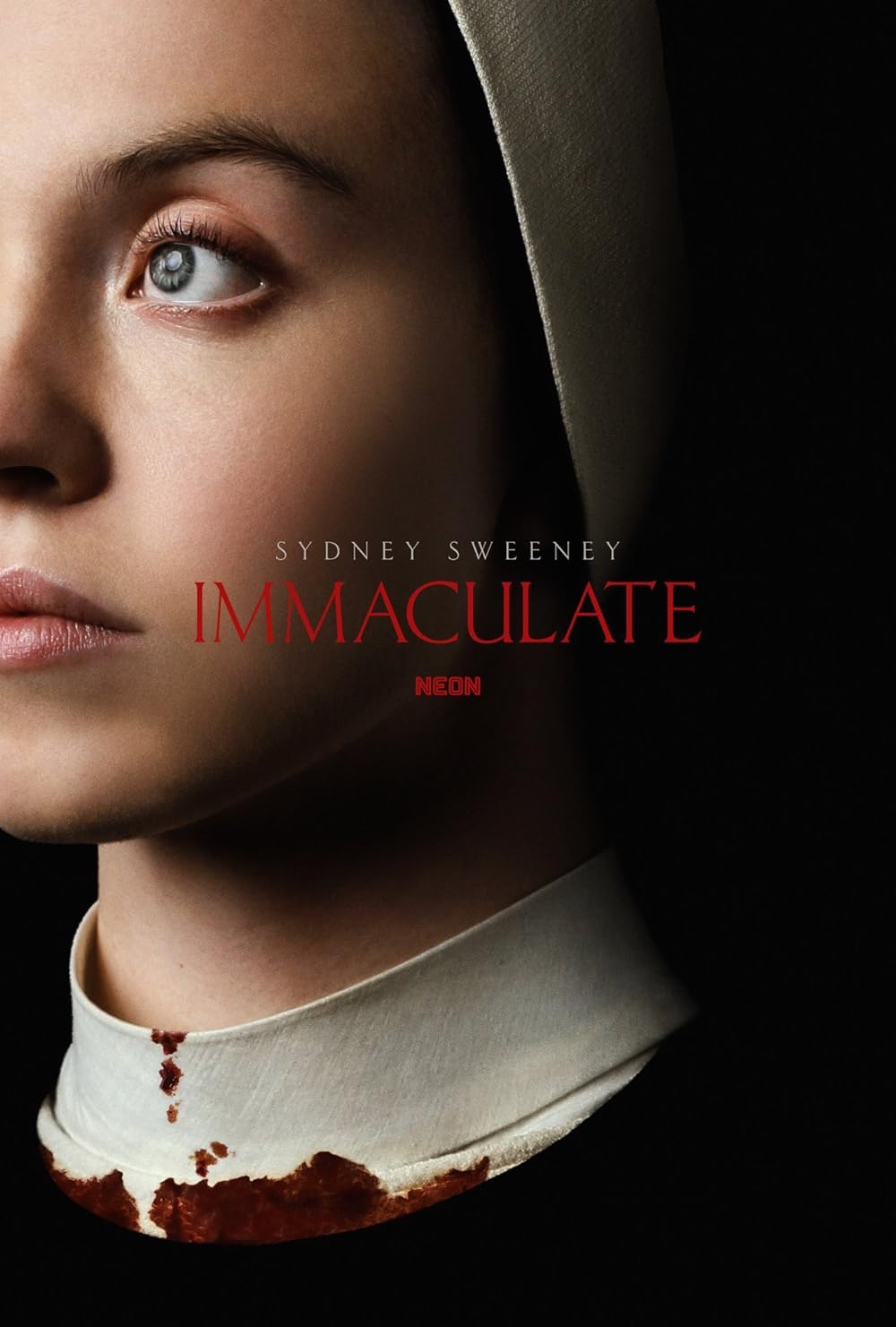
You’d be forgiven for thinking that we’re in a glut of the sub-genre that is Catholic horror movies, after last year’s The Nun II (2023), the upcoming First Omen (2024), and now Immaculate, directed by Michael Mohan and written by Andrew Lobel. How about, for once, a horror movie where a couple of atheists sit around while strange noises occur and they dismiss it as the pipes, before turning up Eastenders?
Sister Cecilia (Sydney Sweeney) is invited to reside at a beautiful Italian convent despite not speaking the language. (A hokey bit of plot convenience if ever there was one.) The convent houses a majority of elderly nuns cared for by younger ones, as much convalescence as cloister. As time passes, though, Cecilia grows suspicious. Why are the priest and the bishop suddenly obsessed with whether or not she’s chaste? What lies behind the creepy atmosphere? Things reach a head when it transpires that she’s no longer fasting for one…
Immaculate has been getting relatively good reviews for a piece of cheapo claptrap, and I’m not completely sure why. Sydney Sweeney’s performance has come in for particular praise. It’s good, don’t get me wrong. She’s a good actress. But it’s competent performance in service of a nothing role.
I suppose what annoys me most about Immaculate is that it’s a Catholic horror film by people who don’t know the first thing about their subject matter and aren’t all that interested in making it thematic. The story is beyond unbelievable if you know anything about theology or history or even just what words mean.
I’m reminded of Stigmata (1999), the film where Patricia Arquette plays a hairdresser who starts displaying the holy wounds that Christ suffered on the cross. She exhibits symptoms commonly associated with demonic possession, the film not understanding that that’s not how proximity to Christ’s experience works. Since, you know, Catholics don’t tend to regard Christ as a demon. Likewise, when Sweeney learns of her immaculate conception, she’s downcast and asks in a piteous voice, why me? Would a devout noviciate, convinced of God’s intercession throughout her life, be quite so glum and suspicious about this news?
A complex response to immense and miraculous events focusing themselves on her would be fine; in fact, more than welcome. Perhaps she’s somewhat dubious, afraid, unsure that she’s up to the task. We get none of that here. She responds, I’ve just realised, comparably to how an atheist would if they were for some reason staying at a nunnery when they inexplicably became pregnant.
Moreover, if you were one of the holy people charged with overseeing Jesus 2.0’s entrance to the world, would you foster a convent of lies and brutality where Christ’s mother is interrogated like a common harlot, scared, slapped around, almost drowned by a crazy fellow nun, etcetera?
This is becoming a bit of a bugbear for me, but movies like this seem to think that pregnancy is just holding a bun in the oven for nine months and that nothing short of a bazooka to the belly button can interfere with gestation. Unless you want your saviour to be either stillborn or profoundly disabled, maybe work harder at convincing the mother that you’re a touch more “Kumbaya, my Lord” and less Spanish Inquisition.
It’s hard to begin with how stupid this film’s plot is, especially without giving things away. I will say that it has an attitude to and use for relics that would seem ridiculous in an episode of Blackadder. The story tries to have a patina of scientific relevance about it, by making one character a former scientist and introducing an underground lab with deformed foetuses in jars, but it doesn’t even rise to the level of hokum.
There is zero reason why a modern Catholic institution – and we know this is the latter day because we see a mobile phone – would believe that the relic in question is actually what it purports to be. No one even bothers to explain how it can be used to do what it does besides some mumbling about DNA, although that’s almost beside the point. The bigger question from a story perspective is: if the conception involves the application of foreign DNA to a host body, how the flying circus is it “immaculate”?! By the logic of the villains, any woman who undergoes IVF – or experiences pregnancy without penetration, such as happens sometimes when a man prematurely ejaculates – has hosted a potential saviour of mankind.
(The “immaculate conception” in theology actually refers to Mary herself, and Jesus’s conception as the Virgin Birth. Though again, if Sweeney’s character is immaculate, why is she treated with such hostility and violence?)
The Catholics in this film are really Satanists, and it would have made a lot more sense to make them so. Especially since the film so clearly wants to be a sort of inverted take on Rosemary’s Baby (1968). What it doesn’t understand about that film, though, is that it was grounded in the everyday and distinguished by underlying sociopolitical themes. The occult aspect, whether or not Rosemary is really carrying Satan’s baby, might be the least interesting thing about it. The tension comes from how Mia Farrow’s Rosemary is repeatedly and systematically disempowered by those around her, cut off from her girlfriends who could support her, coerced into accepting “medicinal” beverages from her neighbours (allowing them into her pregnancy without her permission), etcetera.
Immaculate tries to evoke something similar, but it’s a case of knowing the words, not the music. Two young nuns other than Sweeney’s Cecilia are (very) lightly characterised, Sister Isabella (Giulia Heathfield Di Renzi) and Sister Gwen (Benedetta Porcaroli), the former as troubled and forbidding, the latter your standard-issue Sassy Nun who makes her Sisters giggle before Mother Superior’s stern countenance. The film touches on themes of misogyny, but only by dint of what it shows; it has no real interest in the subject. There’s also a handsome mercurial priest called Father Tedeschi (Álvaro Morte), to embody patriarchy. Morte does his best with the role and is good at conveying both charm and menace.
Although I haven’t talked about this yet because I’ve been too wrapped up in how moronic the story is, most of Immaculate is little more than Sweeney walking around while loud bangs occur on the soundtrack, for diegetic reasons that are barely justified. The movie holds your attention for a bit because it is mildly interesting to think about where it’s going, but every single bang reduced my tolerance. BANG! A bird hits a windowpane. BANG! Hands come through a wall. BANG! I don’t know what that one was! It grows incredibly monotonous.
The film’s ending is in such spectacular bad taste, following the worst possible action that it could imply with Ave Maria over the end credits, that I wanted to admire it. But being so bereft of ideas beyond “wouldn’t it be shocking if…”, it simply feels juvenile. Immaculate is boring and obnoxious in its storytelling and has a plot that could be debunked by a Year 8 Religious Education student. It’s redeemed somewhat by a cheerful goriness, though not enough to be much more entertaining than catechism.
Rating: 1.5/4
 I Just Saw
Leave a comment