
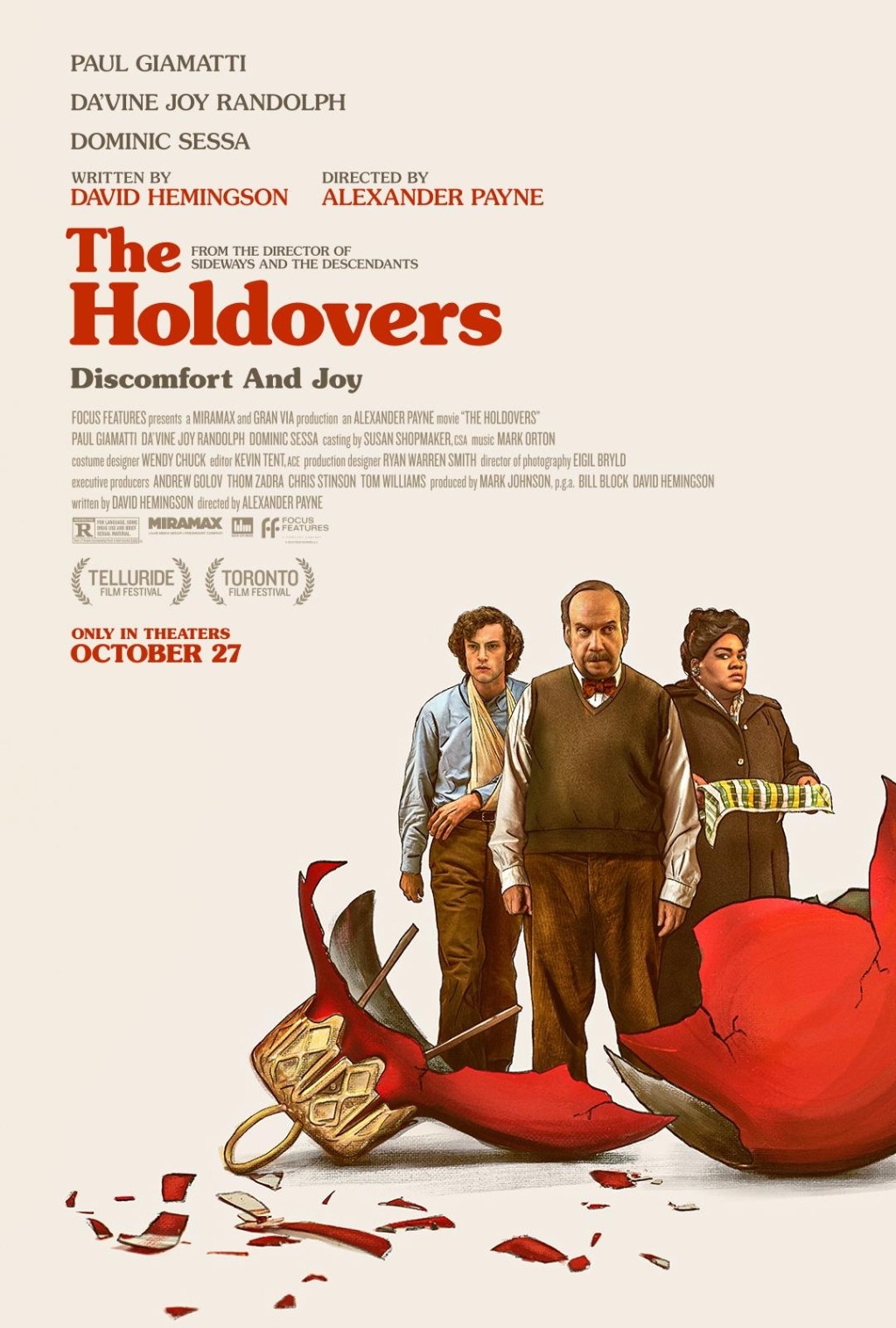
I saw The Holdovers and really enjoyed it. I saw it on a whim when a friend suggested it, and approached the film almost reluctantly, thinking that it seemed like one of those formulated Oscar-bait dramas that get awards because they’re about important themes. I also hate coming-of-age films, and the marketing made it seem like unoriginal, coming-of-age Oscar-bait. However, when one character says that for most people life is a henhouse ladder, “s****y and short”, I started to thaw. By the time Cat Stevens was partway through crooning “I listen to the wind of my soul”, I was completely sold. The Holdovers is formulated, but it’s formula done remarkably well, a sweet and mellow, funny, moving, mature dramedy.
Paul Giamatti plays Paul Hunham, cantankerous teacher of classics at an exclusive boys’ boarding school who in the winter of 1970 is stuck babysitting five students over Christmas, since their parents won’t be having them for the holidays. These are the titular holdovers, including troubled Angus Tully (Dominic Sessa), while also stuck at school is Mary Lamb (Da’Vine Joy Randolph), the kitchen manager, haunted by the death in Vietnam of her only child. When circumstances lead to these three being alone together as Christmas approaches, Hunham’s reclusive and ascetic tendencies create friction with Tully’s peevish loneliness. Mediated by a grieving Mary, however, a friendship born of necessity develops.
The Holdovers is shot on film and comes with ‘70s-era movie logos and scratches on the print. Writer/director Alexander Payne has joked that since he’s spent his career continually making ‘70s comedies, he might as well set one in that time and place. Many other films have furrowed this ground and stitched together these elements, of course. Dead Poets Society (1989), which starred Robin Williams as another boys’ school teacher brought low by bureaucracy though (in his case) bonded with adoring students, comes to mind.
I never liked that film, found it falsely sentimental, saccharine, and hollow. Where The Holdovers massively improves on it, I think, is in the specificity of its characterisation and greater grittiness. Paul Hunham is a real and complicated person, not a cartoon genius (though extremely gifted mentally), not a handsome god in the machine, not a caricature. He’s difficult, austere, profoundly standoffish, and with a core of wounded idealism. He’s the type who uses his intellectual passions as a shield against life, and in one very funny scene tries to connect with two men at a bowling alley bar by lecturing them on Santa Claus myths. He’s also empathic underneath all the bluster and spite that causes him to be hated by both students and faculty. and his scenes with the excellent Randolph as Mary Lamb are some of the most moving.
His growing friendship with Angus is deeply affecting and frequently funny, leading to one of the film’s biggest laughs when Hunham reveals the roots of his tenure at the boys’ school in a liquor store. The period soundtrack is a pitch perfect Greek chorus to the story as it unfolds, and I came to love the three characters, all of whom are haunted by loss and loneliness, but each of whom isn’t defeated yet.
Rating: 3.5/4
 I Just Saw
Leave a comment