
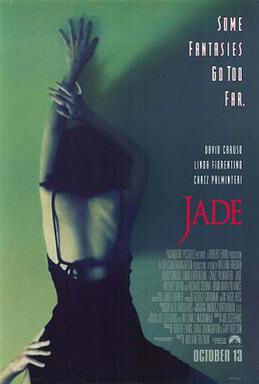
Why was Joe Eszterhaz the highest-paid screenwriter in Hollywood at one point? Maybe I need to watch more of his movies to find out, but I’ve seen a fair few now, and my overall impression is that he’s a witless hack who can’t write well-motivated characters and can barely even plot coherently.
Harsh? Perhaps. But it seems as though his relative artistic successes are down to capable direction and performances, and even then there’s only so much they can do.
He finally started tanking his career with Showgirls (1995), a moronic soft-core melodrama that became one of cinema’s most infamous flops. He then capped it with An Alan Smithee Film: Burn Hollywood Burn (1997), an unpleasant “satire”, of the industry that made him filthy rich; and which was so bad that it earned just 59,921 dollars on a budget of 10,000,000. Classy.
Notable features of his writing include ham-fisted pseudo-erotica mixed with pulpy violence. Hence Basic Instinct (1993), possibly his most successful film in terms of cultural impact. He’d return to its themes and genre with Jade, in the same year that Showgirls fell on its face. I’ll say this for Eszterhaz: he was an important voice in the ‘90s craze for erotic thrillers, a genre whose death knell was sounded by internet porn.
David Caruso plays an assistant DA on the case of who tied up and skinned a millionaire art collector with an antique hatchet. The dead man’s seafront home was rigged with secret cameras collecting blackmail material on powerful men, including the governor of California, papped with a teenage sex worker.
The woman when questioned reveals that all of the millionaire’s parties were attended by a mysterious woman called Jade, whom everyone wanted because she was willing to do things that no one else would. (This height of sexual depravity seems on the evidence to just mean “anal sex”. Scandalous.)
Jade bears a striking resemblance to the wife of Caruso’s friend (Chazz Palminteri), a psychologist played by Linda Fiorentino. Also Caruso’s ex, she has a theory of “hysterical blindness”, to do with how people block out certain things that they’ve done to maintain their self-image… (The cast of Jade, for instance, after this movie came out.)
The characters are oddly lifeless, so that scenes that should be shocking and/or titillating are without human interest, like textbook illustrations of sex and violence. It’s often and rightly been said of Eszterhaz that he can’t write women, but he’s not so good at writing men either. The male characters in his thrillers are rarely likeable or even relatable.
Caruso is a little less of a troglodyte than Michael Douglas’ coke-addled, tourist-shooting cop in Basic Instinct, but he’s still a sour and humourless square. Noir characters don’t have to be this way; just look at LA Confidential (1997), Chinatown (1974), and most films in this genre. Their characters are flawed, though with personalities that you can sympathise with. Eszterhaz, though, doesn’t really write men who aren’t dick-swinging, mean-spirited, hyper-aggressive pricks with no depth.
The most interesting thing about Jade is its titular character. In what for me was the movie’s best scene on a story level, the governor’s illicit sex partner describes Jade, a mysterious and seductive presence whom she’d like to meet (she likes women more than men, she confesses). The men at these Epstein-esque parties all talk about Jade as this dream-like sexual icon, willing to debase herself in ways that even other women lured into that web will not.
Who is this person? If it’s Fiorentino, what would drive a wealthy professional woman to be used like this? (Although, plot hole: if she moves in the same circles as the men at these parties, then she wouldn’t be used in that way. The Jeffrey Epsteins of the world prey on young, naive, and socially vulnerable people for a reason.) If she isn’t Jade, then what drives any woman to embrace the underground of sleazy sex with old, rich men, so completely that she comes to be idolised by them?
Bizarrely, Eszterhaz has no interest in any of these questions. It’s the premise, title, and core of his screenplay, yet he treats it like window dressing and doesn’t even try to explore Jade as anything more than an excuse for sex scenes. And there aren’t even many of those, at least not in decent detail like you’d see in other erotic thrillers of the time. For a writer obsessed with female sexuality, Eszterhaz is utterly incurious about women except as iconic objects. Erotic totems, not people.
The mystery is sort of engaging, up to a point, if you like mysteries. Raymond Chandler could have turned this plot into something special. Critics at the time said that they found it confusing, but I had no issue; I think that the edit’s been cleaned up since then. A new cut was released shortly after the first, following complaints that its conclusion was incomprehensible.
Director William “The Exorcist” Friedkin does a brilliant job with this material and makes as good a film of it as it was possible to make. The central car chase is magnificent, a tense and effective piece of vehicular ballet. It means little story-wise, but as supporting player Michael Biehn observed, Jade had everything going for it except a script.
Rating: 1/4
 I Just Saw
Leave a comment