
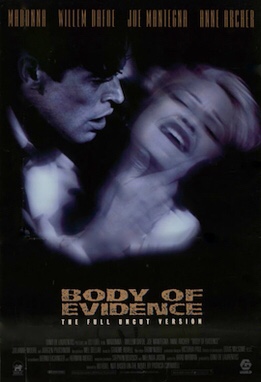
One of the more famous movie disasters, Body of Evidence is surprisingly entertaining as a film to watch with friends, so long as you’re comfortable watching sex scenes together. It stars Madonna at the tail end of a string of panned movies, the previous entries being Shanghai Surprise (1986), Who’s That Girl (1987), and Bloodhounds of Broadway (1989). She plays opposite Willem Defoe in a plot that’s a straight steal from Basic Instinct (1992), just set in the world of lawyers rather than police officers.
Rebecca Carlson (Madonna) is… someone (a socialite, maybe?) who engages in sadomasochistic sex with her millionaire lover when he dies of a heart attack, seemingly while watching one of their encounters on tape. She seeks the defence of lawyer Frank Dulaney (Willem Defoe) and ends up seducing him despite his marriage to Sharon (Julianne Moore), with whom he has a child.
The mystery twists and turns, involving nasal spray laced with cocaine and a private secretary played by Anne Archer who may know more than she lets on. Meanwhile, Rebecca and Frank have lots of kinky sex to the strains of early ‘90s saxophone music, like soft-core porn you’d find on a cable channel.
It’s commonly acknowledged among film fans that Madonna can’t act, and this isn’t the film to change your mind. Clearly she fancied herself a film star and had clout enough from her music career to keep getting work. Her string of disasters would have sunk any actress who didn’t have a bona fide pop legacy to fall back on.
She isn’t as punishingly awful here as she is in Swept Away (2002), but she illustrates why you need more than a great body to evidence talent. Sharon Stone did this same role a million times better in Basic Instinct, not because of her appearance or willingness to show her vagina, but due to her ability to portray alternating shades of persona.
Madonna, by contrast, has no shades. Take a scene where she asks Julianne Moore to wish her luck and gets a slap in return. Why did she do that? What was her motivation to antagonise her lawyer’s wife? With Stone, you would know. She’d have venom in her voice and daggers in her eyes. With Madonna, you have no idea, and not in a good way. In a “this character has no core” way.
The film is nonetheless remarkably more entertaining than you’d expect it to be, especially on a Bad Movie night with friends, where you can cringe at absurd sex scenes and laugh at convolutions in the plot. Especially if, like me, you have a fondness for genre schlock of a different era.
Body of Evidence is a ‘90s erotic thriller to its very marrow. It couldn’t have been made like this at any other time. If it came out now its sex scenes wouldn’t be nearly as graphic or questionable, with assault, public sex, and full frontal nudity from its high-profile lead actress. Furthermore its salty and ludicrous dialogue, horrendous gender politics, and so on.
I don’t present these things as “positives”, necessarily, at least not in an artistic sense. They’re genre elements that you can squirm and laugh and jeer at. You want to see a trashy movie where a pop star simulates sex on the glass-strewn hood of a car in a darkened parking garage? Body of Evidence is for you.
Rating: 2/4
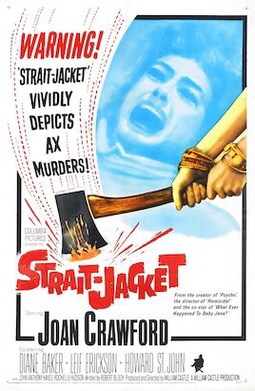
One of the “hagsploitation” films that Hollywood beauty queens were reduced to once their youths dried up, director William Castle’s Strait-Jacket is a combination of patterns from Psycho (1960) and What Ever Happened to Baby Jane? (1962), the latter of which also starred Joan Crawford.
Furthermore, it’s written by the same author behind Psycho’s original novel, Robert Bloch. The story has its moments, though it leans a lot more towards trashy melodrama than the finely honed thrills and rich undercurrents of those films from which it derives.
We begin with Crawford as a temptress who returns home to find her younger husband in bed with another woman, at which point she promptly snaps and beheads them both with an axe while her horrified daughter looks on. She’s declared insane and, 20 years later, returns home to find her adult daughter engaged to an eligible man. Her family is determined to help her rehabilitate, but when more axe murders occur, it seems as if she never should have left the asylum…
The early scenes with Crawford returned home have an oddly moving, even elegiac quality, thanks largely to Crawford’s talent. Her portrayal of a fragile mother and psychiatric patient, newly released after long confinement, is vulnerable and sensitive. It’s an A-list performance of a C-grade character, adding depth where little likely was in the script.
Less convincing is the material around her becoming a wildcat again, given a makeover and some scotch, clinging to her daughter’s fiancé like a dog to someone’s leg. The implication is that fashionable clothes and liquor turn her back into a man-eating slattern. This is the pulp element and very much of its time.
In a way, the film feels like a battle between Castle’s natural hackery and Crawford’s innate talent. Castle was a filmmaker like Lloyd Kaufman, an industry bottom feeder for whom the job was solely about making money. (As opposed to, say, Ed Wood, who loved moviemaking even through financial disaster.)
Crawford is the soul of this film, evoking a tragic, pathetic old woman who loves her daughter but doesn’t know how to do right by her. The scene where she pleads her daughter’s case to her fiancé’s mother is genuinely poignant. This deeper characterisation shines through Castle’s pulpy framing of her as a mad lush who can’t control what’s between her legs once the drinks trolley is wheeled out.
Funnily enough, Strait-Jacket shares the same problem that’s been commonly attributed to the otherwise perfect Psycho: it adds a scene of dry exposition explaining everything that’s happened once the plot is over. We even see a dictaphone dragged out to explain a strange nursery rhyme that someone overheard when that would have been much more dramatically effective as a figment of their imagination.
The film should end with the previous scene, as the characters realise their horrible losses, fates, and psychoses. Still, for a Bad Movie night, Strait-Jacket is a fine choice.
Rating: 2.5/4
 I Just Saw
Leave a comment