
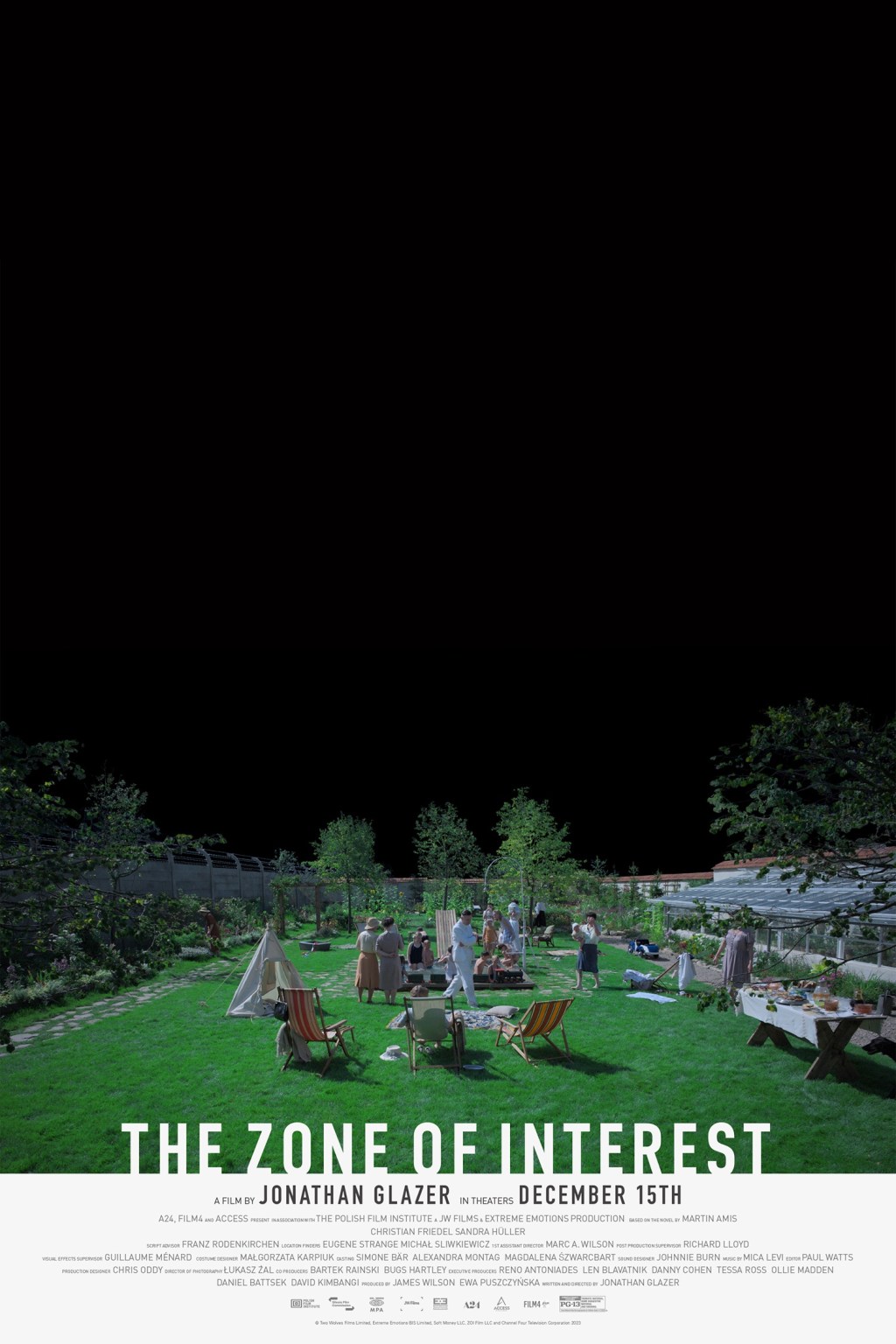
The first thing I noticed about The Zone of Interest was its certificate. 12A. The equivalent, I suppose, of PG-13 in America. Most adult-oriented films about the Holocaust (or any genocide) would presumably earn a higher rating given what it needs to depict. Schindler’s List (1993), which I was shown in school, is a 15.
But that’s the thing about The Zone of Interest. What a film in the Holocaust “genre” (if it can tastefully be so termed) would normally need to depict is deliberately backgrounded here. Strip away all of the historical context and ominous atmosphere, and what you’re left with is a beautifully shot and acted family drama which is completely without interest.
Just ordinary middle-class people, including a cleaner’s daughter who’s “landed on her feet” and married a government big shot, experiencing mundane daily dramas. She wants to stay in the countryside with their children. He’s being transferred by his bosses. They dine, they laugh, they fight.
The only thing is, just over the wall that borders their house, the command to drown a man for stealing an apple can be heard. Moreover, a stout, sharp-suited engineer has arrived with plans for new ovens which can burn greater “loads”. And other people’s clothes show up to be divided among the household…
Written and directed by Jonathan Glazer, the film is based on a novel of the same name by Martin Amis, which was about an Auschwitz officer’s obsession with the commandant’s wife. None of that plot description appears to be present in the film, which is the right choice. The essential plotlessness of Glazer’s film is what gives it its power. Christian Friedel plays Rudolf Höss, the real-life longest-serving commandant of Auschwitz (executed in 1945). Sandra Hüller is Hedwig Höss, his wife, who survived the war and lived until 1989.
Other characters, some real and others possibly fictionalised, flit in and out, but Rudolf and Hedwig are our zones of interest. And their zone of interest is the beautiful home they’ve acquired in the leafy, bucolic Polish countryside. The real “plot” of the film has nothing to do with affairs of the heart between officers, commandants, and their wives, but rather the slow, subtle unpeeling of the Höss family – depicted as ideal and serene in the painterly opening shots, a perfect illustration of the Third Reich’s “Kinder, Küche, Kirche” slogan, but over time poisoned by their proximity to the constant belching flames and ash that fill the sky from the camp next door.
We never see inside the camp, just as Hedwig and her children wouldn’t have seen it, but we know what’s going on there. Take the two Höss sons, one still in single digits and the other an adolescent romancing a local girl. In the opening shot of the family by a sun-soaked lake, the older boy carries the younger in brotherly affection. Towards the end of the film, he locks him in a greenhouse in an act of random sibling cruelty. Somewhere inside the children, they’ve absorbed and normalised the evil going on mere feet away. It doesn’t matter how “innocent” you are, how coddled you remain. You can’t live next door to murder and not be tainted.
I was reminded of a story I recently heard about a Russian grandmother celebrating the low price of strawberries, not caring that they’re cheap because they’ve been stolen from a devastated Ukraine. Or the TikTok clip of an Israeli leaving their home to the sound of missiles aimed at Gaza, thanking their government for the safety they feel knowing that those weapons will soon be striking their targets. Those targets being people, homes, communities.
Holocaust media has in recent years started generating a type of fairy tale literature that interprets the largest atrocity of the 20th century through a lens of simplistic goodies and baddies. The Boy in the Striped Pyjamas. The Tattooist of Auschwitz. These are stories of magical innocents trapped in the castles of sneering villains. What’s so remarkable about The Zone of Interest is that more than any other recent work of its kind, it strips away morality and sentiment to show a mundane set of people just like you. It’s not about Nazism. It’s about you.
The Hösses aren’t so different to you and I in their family dynamics, their hopes and dreams. Hedwig talks of farming after the war, of visiting spas in Italy, of raising her children in the best conditions possible. Her fur coat may once have belonged to the woman her mother cleaned for, now probably over the wall, in the pits. Her children may play with gold teeth, no doubt extracted from unwilling mouths. Still, how many of us can say that we haven’t benefitted from barbarity in some fashion? We might not be as complicit as the commandant’s wife, or next door to the children sewing our clothes, and yet… we all have our zones of interest: ourselves.
Inevitably, much has been made of the “banality of evil” in connection with this film. The phrase was coined by the philosopher Hannah Arendt in her 1963 book Eichmann in Jerusalem, about the trial of Holocaust organiser Adolf Eichmann, whom she described as neither a sociopath nor fanatic, but merely a dullard with no ideas beyond improving his station. (Like an extreme version of a middle-manager for a morally questionable insurance group, perhaps.)
Banality is a part of what’s going on in Glazer’s film, though not the whole picture. A more apposite word, I think, would be something like everydayness. The scenes of daily domestic drudgery are reminiscent of the 1975 French feminist film Jeanne Dielman, 23 quai du Commerce, 1080 Bruxelles, wherein the titular character goes through her routine – making beds, cooking dinner – until she goes insane.
Hedwig doesn’t go insane (in the conventional sense), though watching her and her parlourmaids run the household, day after day, brings to mind the same sort of encroaching madness. The film is scored with distant screams, flames, and crackling gunshots, enough beyond auditory presence to not disturb the family at a conscious level, so much as linger in the shadows while they fill their days with distractions. Until the physical effects appear, like when a canoe trip results in hasty scrub downs for the children, following a downpour of ash from Auschwitz’s chimneys.
Occasionally, Glazer pauses his painterly realism to use symbols. Midway through, we see a sequence of flowers in the commandant’s garden, crawling with bees, until the screen turns entirely red and with a constant low roar on the soundtrack. In a sense, it feels a bit like the famous shots of poppy fields used to suggest World War I, except with a perverse and sinister undertone. Stop and smell the flowers, until the blood pours in.
In this symbolic vein, The Zone of Interest has one of the most quietly haunting endings that I’ve seen. Without spoiling it, latter-day footage from Auschwitz is intercut with one character descending a large, empty, echoing edifice. Without insisting on any such meaning, it’s almost like a ghost story. A vision of the “future” gives shade to the “present”, as if in one terrible moment that character sees through time. And realises the legacy of all they’ve contributed to. The Zone of Interest is one of the darkest films about the Holocaust that’s ever been made, despite and because it never looks over the wall bordering Höss’ garden.
Rating: 4/4
 I Just Saw
Leave a comment