
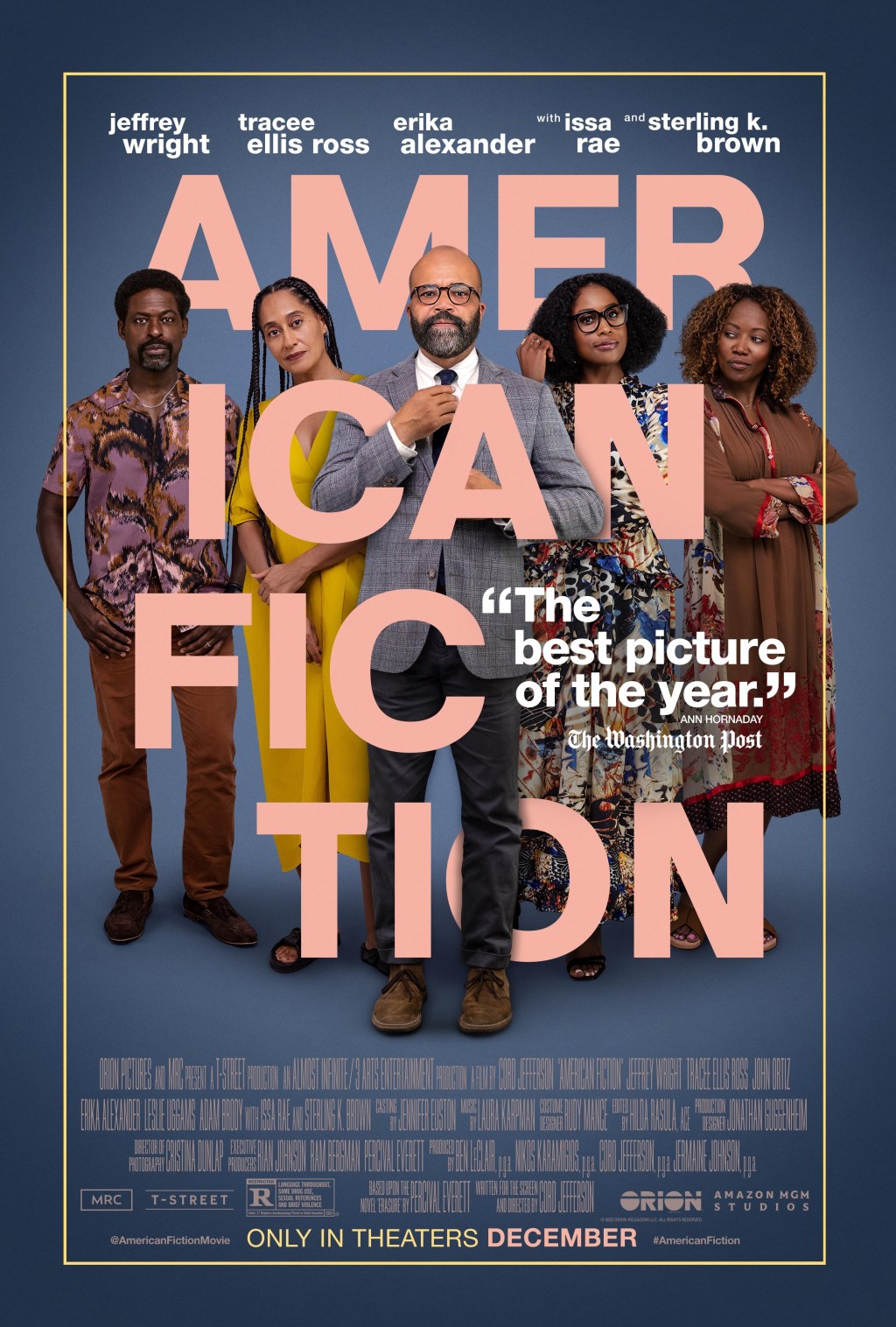
I recently saw American Fiction and it was good. The directorial debut of Cord Jefferson, it stars Jeffrey Wright as Thelonious “Monk” Ellison, a literature PhD and novelist whose upper-middle-class Black experience is a hard sell for publishers looking to flog books.
With his widowed mother’s medical bills to pay, however, he decides to turn out what will come to be called F**k by “Stagg R Leigh”, a ghetto-set melodrama pandering to stereotypes of Black life in America. And the culture eats it up, putting it forward for literary prizes…
American Fiction has been marketed as a raucous satire but it’s better understood as a tragicomedy with satirical elements. At its core is a moving drama about a family, including Ellison’s gay brother Cliff (Sterling K. Brown). Wright’s performance is brilliant, presenting a protagonist who’s not always likeable and sometimes a sneering, conceited ass.
To be honest, I wasn’t enthused about this film because it seemed like an anti-“woke” screed, and its prologue appeared to confirm this. It sees a white, green-haired, flannel-wearing college girl objecting to the n-word appearing on the whiteboard of a Southern literature course. Maybe college students like this exist in America, but I haven’t met many in the UK, and the “nitpicking student feminist with dyed hair” stereotype is one that’s been used to talk over women’s issues for a while now.
Thankfully, the film becomes more nuanced. What I ended up liking about it is that it does challenge preconceptions. No one is truly the villain of this piece, and the story works to consider different perspectives.
For what it’s worth, as a general reader, my own two cents on the themes around publishing are that recent trends aren’t so much about race or identity as they are the need to engage and entertain again. From what we see of “Stagg R Leigh”’s novel, it opens with a murder scene in which the killer explains his pathology to his random homeless victim. Scenes like that draw people in, regardless of what race the characters are.
Mainstream writers have been pilfering tropes from their genre colleagues and studying their craft for decades now. It was back in 2002 that Michael Chabon denounced “the contemporary, quotidian, plotless, moment-of-truth revelatory story” so endemic to literary fiction. Put bluntly, writers in the mainstream became too bourgeois for things like plot, suspense, and imagination.
Interestingly, American Fiction is based on a book from 2001 called Erasure, by Percival Everett, which alternates chapters from F**k with the main narrative. The film takes a more conventional narrative approach, although it does dip into meta-fiction for its ending, which I liked.
One thing I did find funny is that one of the film’s comedic set pieces has a white Hollywood screenwriter share his latest project, a horror movie about a latter-day plantation wedding where slave ghosts attack the guests. This is presented as absurd (it’s called Plantation Annihilation)… but is actually the plot of “Brooms”, my favourite short story from 2023’s Edge of Here, an Afrofuturist collection by Kelechi Okafor.
Admittedly her take was more subtle than whatever Plantation Annihilation would have been.
Rating: 3.5/4
 I Just Saw
Leave a comment