
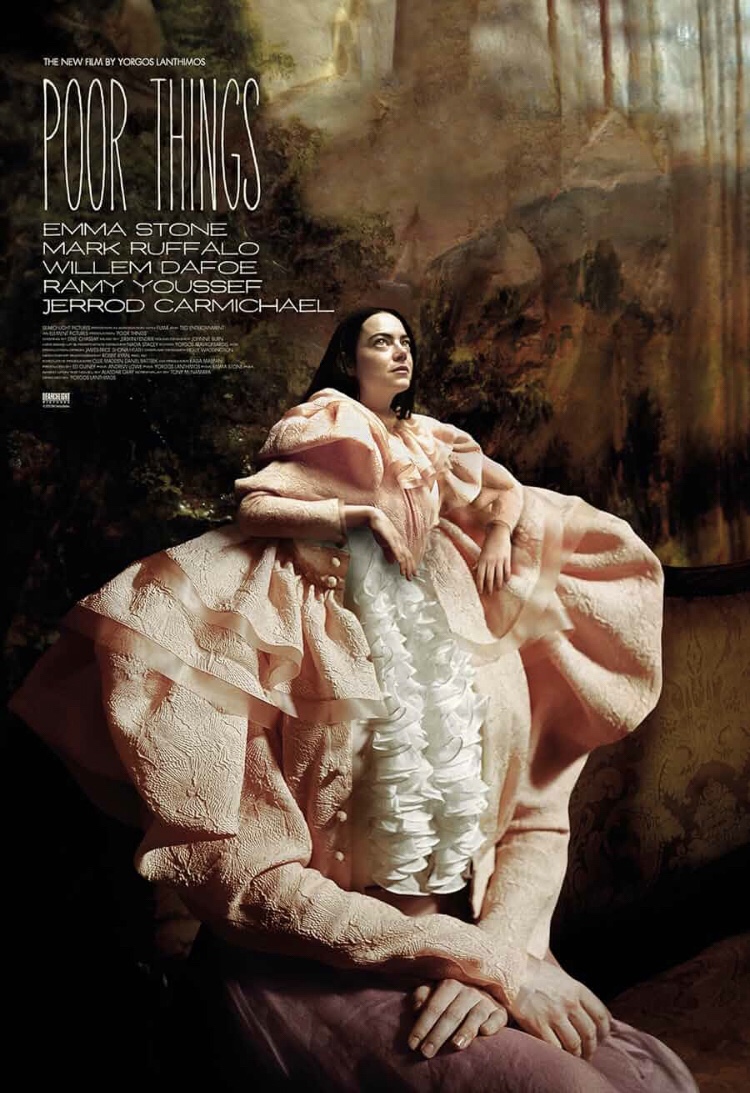
I just saw Poor Things and it was fantastic. In a sense, it’s like the “adults only” version of Barbie (2023) and gives a lot more of what I hoped for from that film: a fundamentally feminist narrative woven subtly within a fantasy tale. Both films are about a woman living a relatively charmed life – but as a prisoner of her specific environment. Something inside them longs to explore the outside, and they do, becoming fully-rounded human women in the process. Poor Things is set in a fantasy version of Victorian society and tells the simple story of a woman’s growth and self-discovery, in a remarkably odd and imaginative fashion. It’s funny, filthy, beautiful, moving, and one of the best films I’ve seen in the last five years.
Directed by Yorgos Lanthimos and written by Tony McNamara, based on a novel by Scottish author Alasdair Gray, the film stars Emma Stone as Bella Baxter, a “pretty r****d” in one man’s words. A Frankenstein-esque creation of Dr Godwin “God” Baxter (Willem Dafoe), she has been made from the corpse of a woman whom we see in the film’s first shot throwing herself from Tower Bridge. Baxter’s assistant, medical student Max McCandles (Ramy Youssef), falls in love with Bella. But her longing for freedom is wetted by Duncan Wedderburn (Mark Ruffalo), a “pretty moron” who takes her on a Grand Tour of Europe during which her childlike state matures, and she finds herself becoming a person apart from what men have always wanted of her.
This is a film with a lot of very frank sex and language, including a refreshingly nonexploitative but still explicit lesbian scene, yet it feels so much more mature than most other Hollywood films which deal with similar material. Lanthimos has explored such themes before in The Favourite (2018), his film about Queen Anne’s fictionalised (and probably fictional) semi-lesbian relationships with her ladies-in-waiting. Both films are leavened by black comedy, although Poor Things reaches further into fantasy. Bella Baxter’s sexual escapades across Europe could have seemed sordid or fetishised in another director’s hands, but Lanthimos handles them with good humour, honesty, and maturity.
The visual look of the film is gorgeous, using saturation, desaturation, black-and-white, fish eye lenses, and other techniques to mirror the emotional as well as physical landscape. The settings are characters in the plot. London, Lisbon, and Paris are evoked with as much magic realism as, say, Mordor or Narnia.
Perhaps most importantly, the characters are developed or revealed with a keen understanding of and compassion for their natures. This is a feminist text, but not preachily so. Bella Baxter is at one level a comment on the heroine of Victorian literature, the abused and “ruined” woman who must kill herself to earn our sympathy. Without even realising what he’s doing, Dr Baxter – himself a victim of a sadistic patriarch – rewrites Bella Baxter’s story so that she’s not just a prettily tragic suicide, but a New Woman, divorced from men’s hangups about sex and sexuality and who finds the tools to self-actualise. She’s every woman, but also her own woman. Not just a poor thing, or a pretty child, but a human undefined by her sexual choices and how her successive male jailers interpret them.
Rating: 4/4
 I Just Saw
Leave a comment