
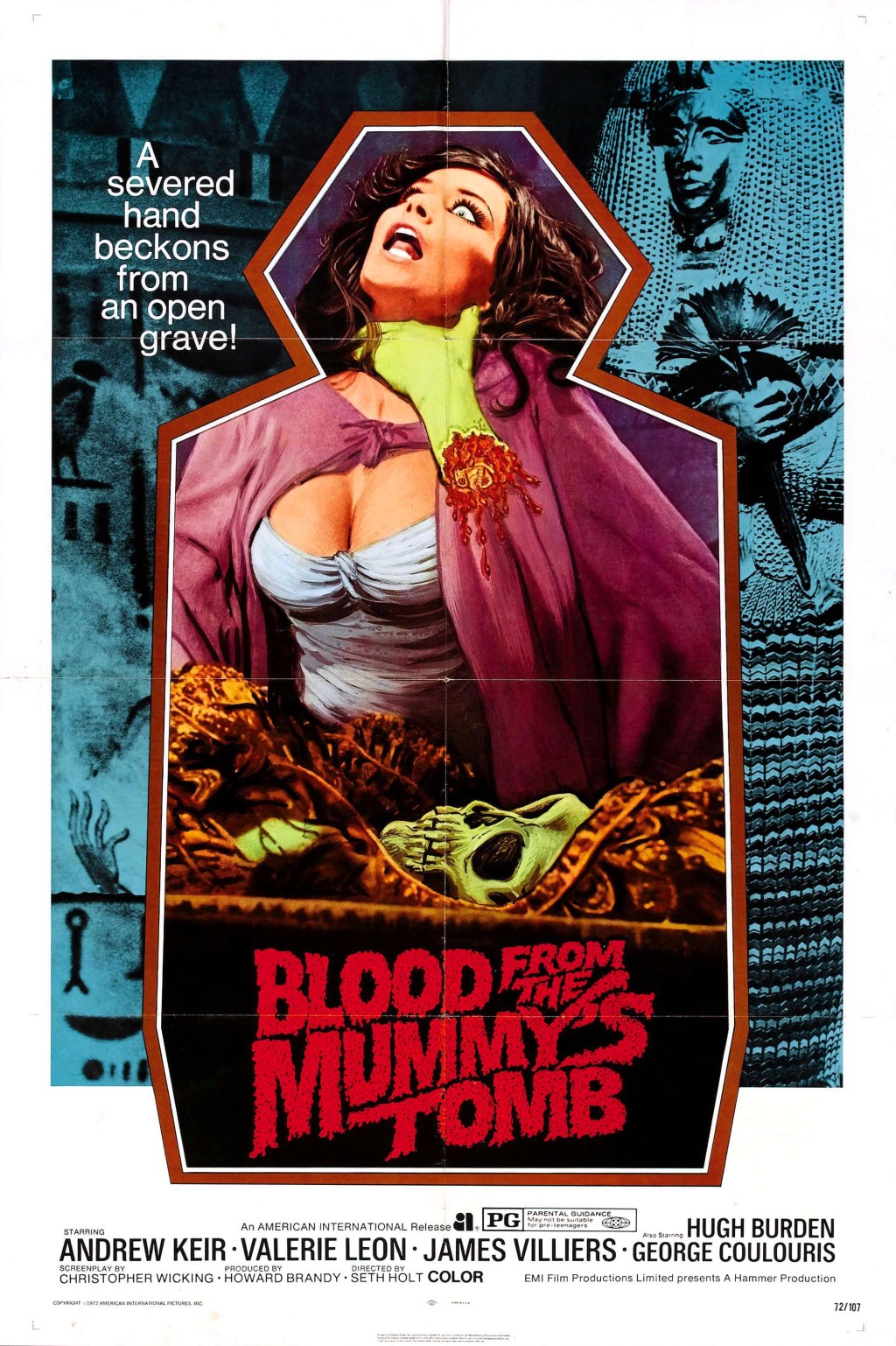
I just saw Blood from the Mummy’s Tomb, the last of the local art centre’s choices for Classic Horror Nights, and it was a jewel, so to speak. Based loosely on The Jewel of the Seven Stars by Bram Stoker, most famous for Dracula, it utilises a lot of the elements of British and Hammer horror, including an attractive and feminine young heroine, antiques, paternalistic scholars, and an Orientalist view of non-Christian religious rites. (It’s hard to escape that the “old/exotic religion” subgenre is rooted in racialism.) But it adds a level of atmosphere and plot development that makes it stand out in the Hammer stable as a remarkable bit of horror storytelling.
We begin in Ancient Egypt, as priests perform a ceremony to kill and neutralise a sorceress, Tera (Valerie Leon), whose disembodied hand commands vengeance that strikes them as they leave her tomb. Come “present day” England, Margaret (also Leon) is gifted by her father a sacred ring, inlaid with a ruby through the red depths of which shine seven stars, the same constellation that witnessed the sorceress’ entombment.
Soon it becomes clear that her soul is seeking to retrieve the artefacts stolen from her tomb by a team of Egyptologists, among whom is Margaret’s father, Dr Fuchs (Andrew Kier). At least one of this former team, Corbeck (James Villiers) has resigned himself to assisting Tera in the hope that he can control her, while another rots in an asylum, awaiting the day she returns for her serpentine familiar…
The source material no doubt assisted with the plotting of this one, although Stoker is known mostly just for Dracula for a reason. Stephen King once observed that he was an otherwise untalented novelist, and Blood from the Mummy’s Tomb probably does well to disentangle Stoker’s convoluted story. It adds a fantastically atmospheric prologue in Tera’s tomb that helps to clarify the central point of the tale, and from there simplifies the storytelling in how it foregrounds Margaret while making her boyfriend, Tod (Mark Edwards), a secondary character. (In Stoker’s original novel he was a barrister called Malcolm and the first-person narrator.) The characters are still basically stereotypes but fleshed out enough to serve the plot-driven screenplay.
The film’s production was plagued. Peter Cushing was originally supposed to play the Keir role but left to support his wife when she fell ill. Director Seth Holt died during filming and Michael Carreras reluctantly took over for the last week of production. Despite these and other backstage issues, Blood from the Mummy’s Tomb has to rank as one of the best Hammer films. It’s got a lot of interesting horror sequences, most notably a scene in an asylum where the camera twists around corridors while the “dawn chorus” of inmates jabber, as well as a haunting final shot across which credits roll. The intricate plot is fun to watch unfold, and there’s a real, almost Hitchcockian suspense here.
This comes highly recommended for fans of supernatural horror, and not just those who enjoy old genre films for nostalgic or ironic reasons.
Rating: 3.5/4
 I Just Saw
Leave a comment