
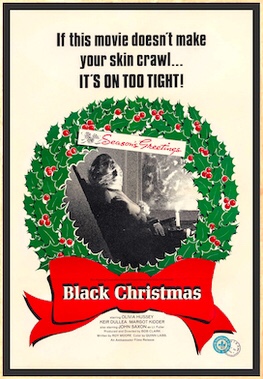
Produced in 1974, four years before Halloween would provide a new zenith for the genre (and six before the decade began that would come to mark its nadir, preceding Scream’s much needed revitalisation in 1996), Black Christmas is a Canadian slasher directed by Bob Clark and featuring probably most famously Margot Kidder (Lois Lane in Superman ‘78) and John Saxon (‘73’s Enter the Dragon, ‘84’s A Nightmare on Elm Street).
The basic plot is borrowed from both an urban legend (“the babysitter and the man upstairs”, a fable for the rotary phone days that would become the basic setup for the slasher genre) and a true crime case that occurred in Montreal. (It also bears resemblance to the Richard Speck murders in Chicago, 1966, wherein Speck broke into a nursing college dormitory and killed eight women.) A sorority is plagued by obscene phone calls around Christmas when in the film’s opening scene a killer climbs the latticework to enter via an attic. When a sister goes missing police get involved, not realising that their killer is closer to home than anyone has realised.
I tend to find with cult favourites from the “golden age” of slashers that many just don’t hold up and are under-characterised, under-plotted nonsense. (Prom Night and When a Stranger Calls, both 1980.) Black Christmas, however, while far from a rousing success, has a surprising amount of elements that work. It’s awkwardly paced and plotted at times, and some of the acting really doesn’t cut it. (It has one of the less memorable final girls – Olivia Hussey’s Jess – a role that should have gone to the much more charismatic Margot Kidder, who instead seems to be playing a parody of a lush.) The best acting is done by Kidder, genuinely funny here and there, and John Saxon as the lead detective.
But it’s always watchable, follows a well-managed tone that vacillates between humour in its first half and mystery throughout, and has some genuinely creepy moments that provide a real frisson of madness.
It also has an ending that I’m almost sure wouldn’t work in most other movies, but bizarrely, does here. When Roger Ebert reviewed the original Saw (2004), he remarked that just once he’d like to see a horror film where the killer is crushed by a canned-goods pallet and we never find out who he is. An idea like that closes Black Christmas, and it’s honestly unsettling, the last shot the sorority house from outside as a telephone rings unanswered within.
I think what makes it and several other moments work is that we do get a sense of a real person, a disturbed personality with a past that exists outside the film’s contrived fiction. We see glimpses of this persona and past in the obscene phone calls, of a lewd sexual nature but also exploiting multiple voices and vague references to child abuse.
The mystery here works somewhat in its skin-crawling fashion, especially when we see the anonymised killer freak out. We watch him destroy things in the attic through his eyes, and want to know more. But we don’t, just as his victims never did.
Rating: 2.5/4
 I Just Saw
Leave a comment