
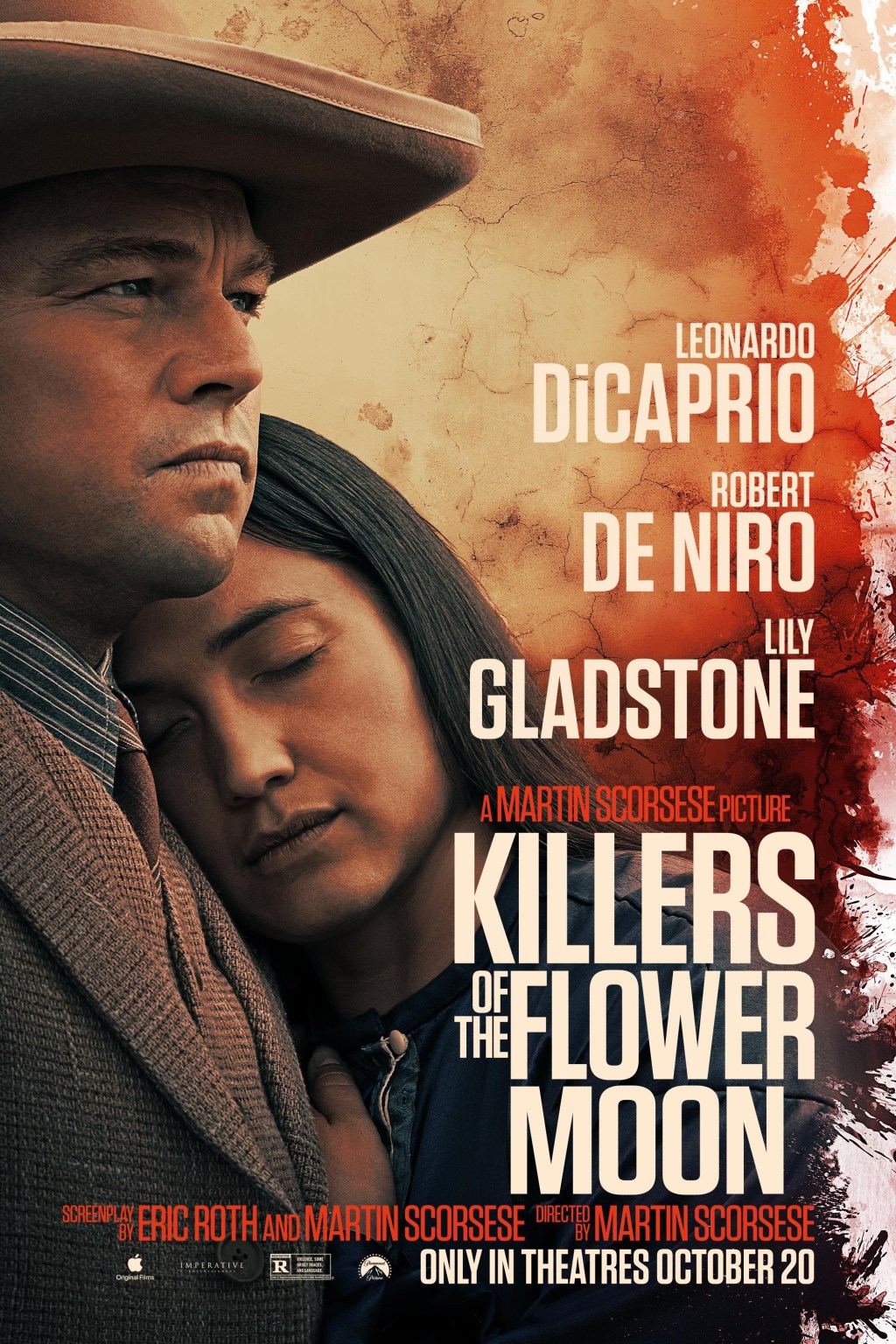
I just saw Killers of the Flower Moon and it was really good. I was trepidatious about seeing it because it’s three and a half hours long, but having booked myself a seat with a lot of legroom and popped out for a comfort break midway through, I didn’t feel the length at all. (Sidenote: why don’t cinemas hold intermissions anymore? The last one I saw was during a screening of 2008’s The Dark Knight. Re-instituting them for longer films is just one of many things that cinemas could do to legitimise themselves again, but apparently won’t.)
Based on a 2017 nonfiction book of the same name and directed by Martin Scorsese, the film stars Leonardo DiCaprio as Ernest Burkhart, an almost literally slack-jawed (he spends the film with a perpetual hangdog Bubba Gump expression on his face) WWI veteran who survived overseas combat working as a chef and has come back home to his uncle’s Oklahoma cattle ranch. “King” Hale (Robert De Niro) is a wolf in sheep’s clothing, seemingly a kindly philanthropist but really a wealth-obsessed psychopath, whose friendship with the local Osage Native Americans hides a determination to acquire their newfound oil wealth. Using his slow-witted nephew as a pawn, he oversees his marriage to the Native woman Mollie (Lily Gladstone), while a series of mysterious deaths plague her tribe and seem to be connected with their marriages to the local white settlers.
I found the film engrossing and was never bored. It’s one of the more entertaining new films that I’ve seen in recent years, certainly in the crime genre, which has often felt too bogged down in generic action, cheesy mood lighting, and such. The three central performances are extremely good and there are some fun cameos when the story becomes a courthouse drama in its third act. It could certainly have been trimmed by at least half an hour or so since there is a large stretch in the midsection that just feels like the same general pattern repeated again and again. A murder is plotted, it’s carried out, Mollie is informed, Ernest and Hale confer, rinse, repeat. But it never became tedious for me, perhaps largely on the strength of the performances and technical elements. The cinematography is beautiful and suspense is skilfully generated with drumbeats, the sound transitioning us between movements and towards revelations in the plot.
On the downside, Gladstone’s Mollie I felt wasn’t foregrounded enough in the film’s latter half. Gladstone’s performance is in its way the most majestic. Every movement of her facial muscles and pronunciation feels perfectly judged to create the effect of a sensible, intelligent woman who perceives more than she lets on but doesn’t quite appreciate the evil in some men’s hearts, since like a lot of good people she doesn’t necessarily think the worst of anyone. A little more suspense could have been found in her deteriorating physical condition as Hale and Ernest “manage” the wasting illness that is flooding through the Flower Moon tribe’s women.
DiCaprio is great in the role of an unintelligent person who never quite understands what he’s doing or what’s being asked of him. His motivations were what captivated me for much of the film since I wasn’t quite sure just how complicit he was in the psychopathy of his uncle. In a way, he’s a victim too, a passive dim-bulb who was unfortunate enough to have an evil benefactor as opposed to one that would have made something better of him.
And then there’s De Niro as that malign entity. This film is another reminder that he is one of Hollywood’s most charismatic and powerful actors when he’s not prostituting himself in utter junk like Dirty Grandpa (2016) and Little Fockers (2010). His Hale is pure Iago. A Machiavellian schemer who seems to commit skulduggery almost reflexively, as if he could be the richest man in the world and still plotting to overthrow the general store just because that’s what he does. What else is he supposed to do, attend to his cattle? A large part of the intrigue in this film is watching this man with an oil sump where his humanity should be playing next-level chess with the townsfolk, engineering convenient shootouts with a word in the right ear and burning whole swathes of his crops just for the insurance money. Watching Hale, I was reminded of the BBC’s recent drama about Jimmy Savile, The Reckoning. While motivated by different things (Hale by money, Savile by sexual depravity), they’re kind of the same person and the same phenomenon, products of a system that prioritises men who look and sound like them to the degree that their malfeasance isn’t recognised. But they recognise the flaw in the system, and spend their lives exploiting it.
The ending of Killers of the Flower Moon is fantastic and bumps it up a notch in my ranking. It’s fairly audacious in how it calls attention to the cheap tricks and stagecraft of the true crime genre. I suspect that it might even be Scorsese commenting ironically on the proliferation of true crime podcasts, showing how they’ve always been around in some form, real human tragedy used as entertainment for the masses.
I’m reminded of a line in a Friday the 13th movie of all things, Jason Lives (1986), where a gravedigger turns to the camera and says: “Some folks sure got a strange idea of entertainment.” It’s the director winking at us, letting us in on the joke of it all, but in Scorsese’s case also using that irony to underline the deep and lasting poignancy of this tale, told by white people long after it happened.
The film opens with the Flower Moon lamenting the loss of their culture to settlers, and ends with their story being told by those settlers. The last line spoken in the film, and who it’s spoken by, was to my mind the most important.
Rating: 3.5/4
 I Just Saw
Leave a comment