
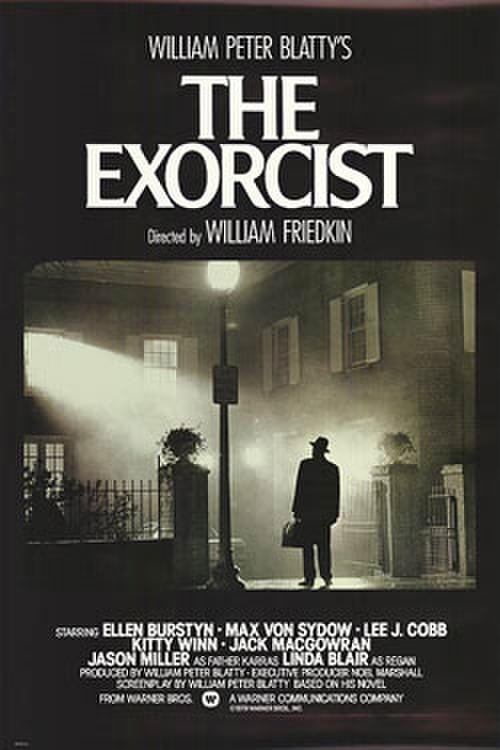
By way of what I suppose is full disclosure, The Exorcist happens to be my favourite film. I’ve seen it on the big screen twice now, the first time two or three years ago and latterly for its 50th anniversary. It remains an utterly compelling motion picture, about faith and guilt and love, told through the medium of horror fiction. Watching it right after the trailer for the upcoming Blumhouse “sequel” (The Exorcist: Believer), which my theatre played twice in succession for some reason, the fundamental difference between the two is clear, Ellen Burstyn’s return aside and even without me having seen it yet.
The story of the original should be well-known by now, but nonetheless: Chris MacNeil (Burstyn) is a celebrated actress in Georgetown, Washington when her preadolescent daughter Regan (Linda Blair) starts exhibiting signs of demonic possession. This being the late 20th as opposed to the 17th century, various medical and psychiatric avenues are exhausted before Chris contacts Father Karras (Jason Miller), a priest-cum-psychiatrist who’s losing his faith while dealing with an ailing mother. He and exorcist Father Merrin (Max von Sydow) end up leading the charge against devilry, as Regan’s condition requires her to be confined to her room.
The trailer for Believer, on the other hand, is clearly representing a rattle-and-scream, escape room whirligig for teenagers (it’s rated 15 to the original’s 18), another Blumhouse “update” and of a genre which I often have to watch with earplugs in. The Exorcist, meanwhile, wasn’t made with anything like the same goals and intentions. It’s not “just” a commercial product but an art piece telling a story that meant a great deal to its writer William Peter Blatty, and its director William Friedkin.
As such, it doesn’t appeal to the same need for constant, maximum stimulation. Without falling into “le wrong generation”-esque nostalgia – probably just as much crap was being pumped out in the ‘70s as now, relative to how many films were being made overall – it does feel like something that wouldn’t be made today. We talk about “elevated horror” these days but horror has always been capable of elevation. The Exorcist is proof of it.
During the screening I noticed a small group of late teens/early-twenty-somethings sitting near me and whispering to each other a lot in the first act. The Director’s Cut (which is what I saw) especially is a film that takes a lot of time to establish its characters, themes, and settings. As well as a horror film it’s a snapshot of city living in the 1970s; the tenements and hospital and other places that we see Father Karras in are definitive of their period; at the time they would have seemed naturalistic, bringing a gritty social realism to the story that’s painfully absent in a lot of demon possession movies, which focus more on ludicrous set pieces.
The Director’s Cut is a bit of a mixed bag in terms of what it adds. A shot of a demonic face in an oven’s extractor fan feels tacked on (and doesn’t really make sense since none of the characters see it; who was the demon displaying itself for?), as does Lt Kinderman’s (Lee J Cobb) extended subplot. Cobb is a good actor and has a great scene with Karras, but his usefulness outside that scene is limited.
The added material reflects his larger role in the original novel by Blatty, but its reduction in the theatrical cut was wise. (A lot of subplot was cut between page and screen, such as Chris’ European housekeepers and an astronaut whom Regan tells “you’re going to die up there” – those elements appear in the film, but greatly reduced; I’m not even sure that the man at the party is identified as an astronaut.)
One major improvement made by the DC, however, is the re-addition of Regan’s “spider walk” scene, which stands out as the most immediately effective horror image in the piece. Although my favourite shot remains Regan on the bed in silhouette, arms raised towards the sky, beside a silhouetted Pazuzu – the demon possessing her – as wind howls on the soundtrack. For me it’s the film’s definitive image.
The reason why The Exorcist remains my favourite film is in that shot: probably more than any other film I’ve seen, even high fantasy, it evokes a sense of otherworldliness. We’re in an upper-middle class home in Georgetown, a working-class tenement block, a mental hospital… the most exotic (from a western audience perspective) location in the film is an architectural dig in Northern Iraq, in the prologue, with that magnificently unsettling close with the two dogs fighting as Pazuzu looms above. And yet we’re drawn into a world of spooks and spells far beyond what the poet Anne Sexton called “the absurdities of the dinner table”.
I think that that’s what makes The Exorcist so special. It’s not all that “scary” these days in a visceral sense, not if you’ve seen other horror films. But it’s the most rational and involving film that depicts demonic possession as a real thing that’s ever been made, and that grounding in reality is ironically what makes it so otherworldly. The only other great film in this sub-genre that I can even think of is The Exorcist III (1990), both written and directed by Blatty, based on his novel Legion.
(1977’s Exorcist II: The Heretic is junk and regarded as one of the worst films ever made for a reason; it’s directed by John Boorman and written by “William Goodheart”, a screenwriter so prestigious he doesn’t have a Wikipedia page, and whose IMDb lists four movies. Two of which are Exorcist II – one with “alternate opening”; the other two I’d never heard of. Friedkin and Blatty were busy suing both each other and the studio for various reasons, and Boorman stepped up despite hating the original. Honestly, it shows. If you’re curious, I’d honestly recommend just watching the Nostalgia Critic or whomever’s breakdown on YouTube.)
III continues with Lt Kinderman, played this time by George C Scott, and wisely avoids reintroducing Chris, Regan, et al. It’s about the hunt for a blasphemy-themed serial killer who works by phases of the moon and features probably my favourite scare in movies: all I’ll say is that it involves a hospital corridor and a headless Christ.
Even 50 years later, however, the film that started the demon possession genre remains its qualitative apex: nought gets by The Exorcist.
Rating: 4/4
 I Just Saw
Leave a comment