
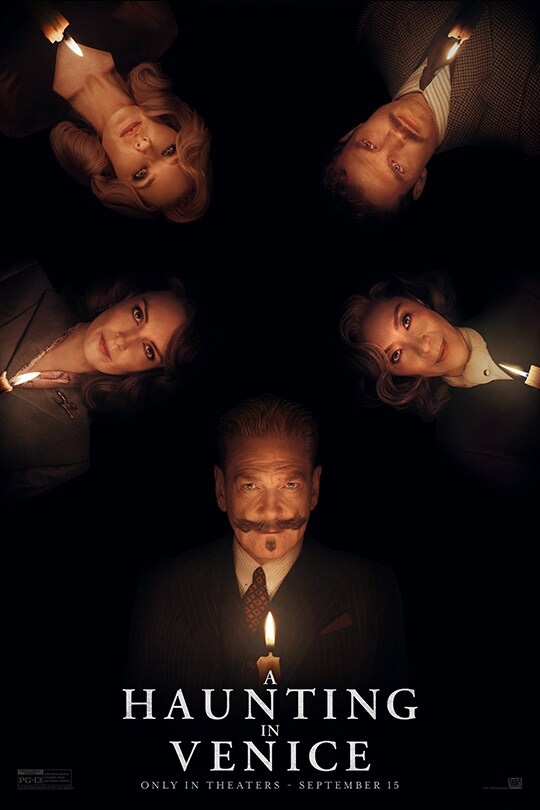
I just saw A Haunting in Venice and it was first-class junk. I’m not sure what Kenneth Branagh’s motivation is to keep making these Poirot adaptations. He doesn’t seem to like the character much and from what I’ve read he’s not exactly making money hand over fist with them. His Murder on the Orient Express (2017) was one of the most perfunctorily made films to boast an all-star cast ever released, and about on the level of a TV film. I didn’t even bother with Death on the Nile (2022) but from what I saw it looked again like a bland TV show starring the usual British character actors alongside A-listers like Gal Gadot. (And unfortunately, Armie Hammer, whose private life derailed the promotion somewhat when it became subject to one of Hollywood’s most bizarre Me Too scandals, involving extreme S&M and cannibalism.)
Now we have A Haunting in Venice, which uses some names and elements from Agatha Christie’s 1969 novel Halloween Party, but otherwise seems geared more towards fans of the Conjuring movies who wondered what they’d be like if they were suicidally boring and inappropriately referenced the Holocaust.
The story is that Poirot (Branagh) has retired to Venice in 1947 when detective novelist Mrs. Oliver (Tina Fey) drags him to a palazzo to participate in a seance on Halloween night. The hostess’ daughter died a year ago, having supposedly flung herself into the canals, and in a touch of crass Orientalism Michelle Yeoh turns up in a kabuki mask to play a psychic. The night is dark and stormy, as such nights tend to be, and a sceptical Poirot finds his faith challenged when supernatural shenanigans lead to murder.
The film doesn’t start that bad. Its cinematography is the best thing about it, and I thought at first that director Branagh might genuinely pull off an effect a bit like Don’t Look Now (1973), the classic Nicholas Roeg film about grieving parents disturbed by what seems to be their child’s ghost in Venice.
It’s not to be, of course. As soon as people start opening their mouths the cliched and asinine script takes over. ‘They say that in Venice, every house is haunted…’ Alright, mate. Furthermore, Branagh’s portrayal of Poirot is once again more mystifying than any of the cases he solves.
I do find these films somewhat amusing just because I’m convinced that Christie anticipated them with Mrs. McGinty’s Dead, her 1952 novel in which Mrs. Oliver talks to a theatrical producer from the West End about adapting her Finnish detective to the stage. She tells him dryly that the character “doesn’t care for women” when he tries giving him a love interest and making him more physical, and in turn, he replies that this is a big-time red-blooded thriller, the hero simply can’t be a “pansy”!
Come the 21st century and what does Kenneth Branagh do? Gives the fey, effete Hercule Poirot a late wife and makes him more physical, storming about locking doors and chasing ghosts. He also makes him an arsehole. My dander had gotten up early when he was walking home through Venice and his bodyguard brutally knocked down a young man begging for assistance with a murderer loose on his family. Lovely. Why not just shave TWAT into his moustaches and be done with it? He’s also a sour sceptic completely without humour, whereas Poirot was a devout Catholic whose characterisation was intended to be light and amusing.
The film is supposedly based on Halloween Party, Christie’s 1969 novel. Apart from a few names and a couple of thematic elements, though, it’s not. The murderer is the same (kind of; it’s hard to explain without spoilers) in the sense that they have the same name and serve (very) roughly the same function, but otherwise, it’s a completely different story. For one thing, Halloween Party has nothing to do with Venice. It’s set in the English commuter belt of the late 1960s and is about a schoolgirl drowned in an apple-bobbing tub when she claims to have witnessed a murder that she didn’t realise was a murder at the time. An idea already a thousand times more interesting than anything in the dreary, monotonous, unpleasant A Haunting in Venice.
The most that I can say about the film is that it was sometimes unintentionally funny, and in one instance remarkably offensive. Maybe I’m too sensitive, but when one character starts talking about the liberation of the German death camps I cringed a little with secondhand embarrassment. Come on, Branagh. This is a silly murder mystery with pseudo-horror elements, a pre-Halloween trifle, can you not? The history of genocide will thank you for not sticking it between your buttcheeks to pick out the corn of your latest project. The funny moments were in the stupidity of the writing. (One last-minute twist about a blackmailer is so moronic it deserves some sort of award.)
No attention has been paid to making the story or characters believable. For example, who are the children in attendance at the palazzo’s Halloween party? I get that health and safety had a way to go in 1947, but I’m fairly sure most parents didn’t let their kids run around crumbling houses where people have died. The film even underscores this with a cheap jump scare where a chandelier almost splatters a roomful of kids up the walls. The hostess can’t sell this house because of its haunted reputation, but little Sally can run around dressed as a princess while chunks of it fall into the sea. Sure.
Finally, the film is just SO dour and boring. Everyone’s miserable, and the script’s not smart enough to justify it. It was only about 100 minutes but it honestly seemed like 3 hours. Well, all I can say is that I’ve been fooled twice now. I’ve no one to blame but myself, but I won’t be falling for it again. Maybe.
Stray observation: The film contains a reference to a famous jump cut from Citizen Kane (1941), which in Welles’ film was reportedly intended to wake up the audience with a sudden loud noise.
Rating: 1.5/4
 I Just Saw
Leave a comment