
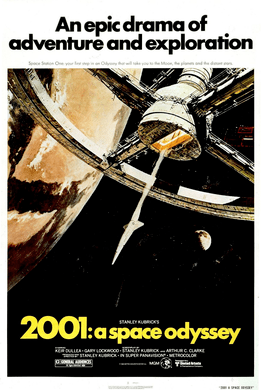
I just saw Stanley Kubrick’s 1968 science fiction masterpiece 2001: A Space Odyssey for its 55th anniversary at my local cinema and thoroughly enjoyed it. I’d seen it before but previously felt that it was a good but cold film, lacking in story apart from the section with HAL 9000 and without human interest. I felt differently this time and enjoyed just about every second, finding myself immersed in the narrative even at its most abstract, symbolic, and philosophical.
As others have observed, it’s practically a silent film, with little dialogue beyond the most functional. It’s fully half an hour before a word is even said. Even then, you don’t need to be paying all that much attention to the dialogue; it’s there to create an impression of characters communicating with each other more than impart specific information. Indeed, the weakest parts of the film for me are still the two video phone calls between astronauts and their families back home, one of which contains some ropey child acting. Even then they’re not bad and certainly serve their function just as everything else does, they’re just relatively kind of stiff and dated, clearly a product of the ‘60s rather than the new millennium, where everything else feels modern.
The story takes us from the dawn of man to the birth of a new species, the next stage in human evolution. We start out with apes in the desert, playing out their animal dramas by day and huddling together in crevices for warmth by night, when they come into contact with an obsidian monolith from which they learn to use bones as weapons. This gives rise to tools, foretelling man’s next step, before (in what’s been described as the longest flash-forward in narrative cinema) a bone tossed into the air turns into a space satellite.
From here the most characterised players are Dr Heywood (William Sylvester), a bureaucratic scientist investigating the appearance of an anomaly on the moon, Dr Bowman (Keir Dullea), an astronaut sent with his crew on a secretive mission, and HAL 9000 (voice of Douglas Rain), a sentient computer monitoring the crew whose artificial intelligence may be giving him malevolent designs…
A lot of the film is taken up with illustrations of futuristic space travel, scored to classical music that was initially just a placeholder but which Kubrick decided to keep as the score. It gives the film a majestically detached quality, which coupled with the pristine and painstaking images of space travellers moving in four dimensions, ships docking, etcetera, creates a tale built out of awe at man’s incredible journey yet inescapable smallness in the cosmos.
There is a plot that unfolds and can be followed from the beginning of the film to the end, but you need to do some intuiting, and interpreting, and not be afraid of symbology. It’s a story that makes me feel at peace and connected with the wider human race, which allows you to stand outside our history as a species and gaze in wonder at both it and the universe that it inhabits. Plus it ends in a trippy light-and-sound show.
Rating: 4/4
 I Just Saw
Leave a comment