
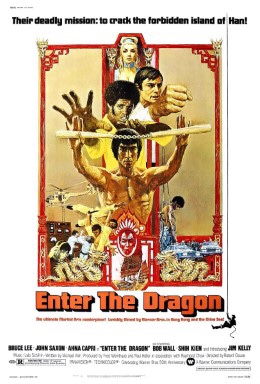
Saw this movie for its 50th anniversary at my local cinema. I’d never seen it before, but it’s one of those movies whose tropes you’re aware of via osmosis. Having finally seen it, I was pleased to have found it a riotously entertaining piece of work, one of the more involving and fun movies that I’ve seen this year.
The last film that Bruce Lee made before he died the same year aged just 32, the story sees him as a martial arts master called Lee, hired by the British government to investigate a mysterious island on which a fighting tournament is held once every three years. Fellow contestants include gambling addict Roper (John Saxon, a mainstay of the horror and western genres, appearing in character roles for Wes Craven in a couple of the Nightmare on Elm Streets) and Williams (Jim Kelly, star of both martial arts and blaxploitation films).
The basic plot of Enter the Dragon is a hodgepodge of tropes recognisable from the James Bond series. Some elements are straight steals, like the central antagonist Han (Shih Kien), an island-bound maniac with a detachable hand, a character modelled on Dr No from the film of the same name (1962). Yet Enter the Dragon never feels derivative so much as a meditation on similar themes and images in pop culture, an illustration of pulp storytelling at its finest.
The martial arts genre is a bit like horror in that for every masterpiece there are about a million VHS cassettes stuffing landfills. The sort of dross that ends up being ridiculed on YouTube channel Red Letter Media’s “Best of the Worst” show. Until Quentin Tarantino’s superlative revitalisation of the genre with his Kill Bill (2003/04) films, it had become kind of a joke in the West, with every flabby dojo owner in Los Angeles fancying himself the next Bruce Lee. (There’s an amusing but possibly apocryphal story about how Steven Segal became a movie star: a producer bet his colleague that he couldn’t make the least charismatic man he knew a success, and so picked out the owner of his local dojo.)
It’s therefore so refreshing to see how Enter the Dragon bothers to construct a real story with characterful set pieces and solid plotting. We get to know each of the three main protagonists, which means that when one of them proves fallible it has a real emotional impact. Besides all the well-choreographed fight sequences that one expects, we get wonderful little scenelets like a praying mantis fight on a boat, a match on which the sailors take bets as the camera gives close-ups of the sparring insects.
Also present are interesting social asides. Before setting sail for the tournament, Williams surveys the wharf with its families packed into cramped and filthy boats and remarks that ghettoes are the same everywhere. Just as it also borrows bits and bobs from the revenge genre, Dragon uses Williams to toss in some blaxploitation too. His first scene sees him slapped with the ‘70s slur “jig” by two police officers, whom he proceeds to be more than a match for. Given how agenda-driven pundits like to complain that modern films are too “woke” in their disrespect for institutions, it’s interesting to see this pre-PC classic show contempt for authoritarian overreach. Saxon and Kelly are fun genre actors and bring love-ability to roles that could have been played meaner.
Lee, meanwhile, is a beautiful man and a charming performer; he evinces cool masculinity without ever seeming detached or brutish, rare for even the best action studs. An element surprising in its absence is the lack of a love interest for him, which makes me wonder if he insisted on that for either personal or cultural reasons. A character who in a Bond or other such action film would normally fill that role appears, the female operative Mei-ling (Betty Chung), but she’s hardly utilised, making Lee seem almost asexual.
Maybe the idea was to show how in control his character is; while Roper and Williams indulge the needs of the flesh with a Chinese harem led by white madam Tania (Ahna Capri), Lee seems above such urges. Incidentally, Capri is a lovely actress, able to do more with one eyebrow and half a smirk than many can do with Shakespeare.
The fight sequences once they arrive are absurdly satisfying. Without showing much in the way of blood and gore they vibrate with dramatic intensity while displaying stage management at its highest level. The choreography is an art unto itself. These scenes run the gamut of emotions from humour to horror and excitement and suspense, capped by a glorious “boss fight” in a hall of mirrors. An all-around brilliant genre piece.
Rating: 4/4
 I Just Saw
Leave a comment