
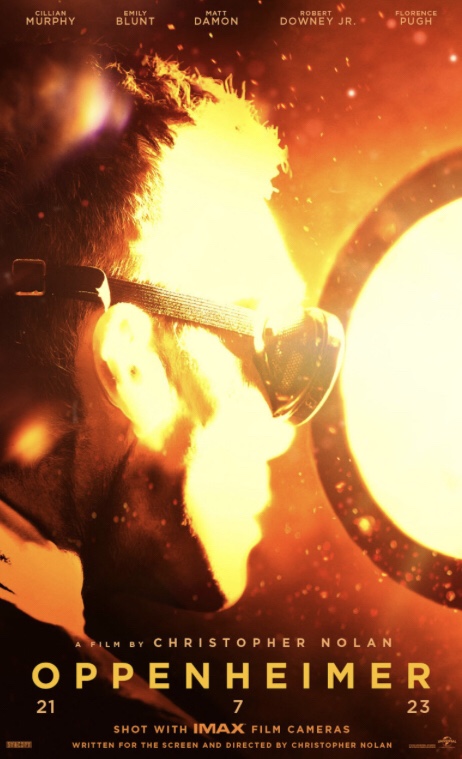
Now that it’s been released, Oppenheimer feels like such a natural project for Christopher Nolan, a writer/director whose works have always been concerned with concepts. He approaches his stories rather like a theoretical physicist, starting with a baseline of plot and twisting it back and forth across many permutations, dissecting time travel, space exploration, unconscious minds, and even moral philosophy in The Dark Knight (2008).
Cillian Murphy plays J Robert Oppenheimer, head of the Manhattan Project, which with a bunch of scientists in Los Alamos created the atomic bomb, dropped on Hiroshima and Nagasaki and thereby ending World War II. The structure of the film follows Oppenheimer from his student days, when he almost murders a difficult tutor with a poisoned apple before an attack of conscience strikes, through the Manhattan Project and to his postwar years when he faced government committees questioning his communist links.
Murphy is a perfect choice for Oppenheimer, both physically and performance-wise. He’s a gaunt-looking actor with very distinctive eyes that can seem anxious, arrogant, and haunted, sometimes simultaneously. “The burden of genius” is not a theme that’s often done well in media, since it’s easy to confuse “troubled genius” with “obnoxious narcissism” when drawing a character, but Murphy and Nolan pull it off here. Murphy brings a quiet authority to his role, a sense that this is a real and complicated person struggling with what he’s capable of bringing to the world, and whether it’s his duty to bring it. A large part of his motivation is to keep such weaponry out of Nazi hands by getting to it first.
For me, though, one of the most fascinating characters was Strauss, the Iago-like businessman who supports before turning on Oppenheimer, played brilliantly by Robert Downey Jr as a man both proud of and insecure about his humble roots (he refers to himself more than once as a former “lowly shoe salesman”). Strauss is presented as the catalyst for Oppenheimer’s postwar downfall, all because of a relatively minor humiliation over a trade matter that he disagreed with Oppenheimer on, coupled with a paranoiac sensitivity to perceived slights.
It’s a testament to Downey’s talent that he brings such subtle depths to this role, which could have been played much more broadly. Instead, I found myself in sympathy with him at times; it must be difficult, surrounded by the pre-eminent and often very privileged scientific minds of your age, to feel like a lowly shoe salesman.
Other great performances that surround Murphy include Gary Oldman’s as President Truman which, although it’s restricted to one scene, must be one of the best portrayals of a US president in cinema, at least among cameo roles. Oldman gives both an oily political surface and a menacing, hard-as-diamond core. Truman has a point when he says that the Japanese don’t care who built the bomb, just who dropped it. That scene in the Oval Office with Oldman’s disdainful sneer is possibly as powerful as when Oppenheimer has a vision of flayed faces and desiccated corpses at a US victory rally.
This is a film filled with great acting. Matt Damon gives one of his best performances as General Groves, tasked with supervising the Manhattan Project. The actor projects authenticity as a macho military man who brooks little nonsense.
Some more great scenes include an interview during the Project between Oppenheimer and a military officer whom Groves describes as having killed communists with his bare hands. That line of dialogue and the interview itself create a similar sense of menace to the later Truman scene, implying terrible, cold-blooded calculation and danger for our main character with just an exchange.
The scenes with the women in Oppenheimer’s life are less successful. They cover the two most important romantic relationships he had, with his mistress – Jean Tatlock (Florence Pugh) – and wife – “Kitty” Oppenheimer (Emily Blunt) – also the mother of his children. To put it crudely, the mistress is reduced to little more than a tragic pair of tits. Nolan is a very masculine writer and of course, there’s nothing wrong with that in itself, but here it means that despite some momentary lip service to feminism (one female scientist is mistaken for a typist), the important women characters are drawn in cliche.
There’s a particularly embarrassing scene where we see the mistress gyrating nude on an also naked Oppenheimer as he gives evidence about their relationship to a committee. (She was a card-carrying communist.) While I understand the symbolism – Oppenheimer feels exposed – it would have been more effective if it was just him we saw, nude. As it is, the scene serves mostly to humiliate both the mistress and wife – who make eye contact in the quasi-dream sequence – in a rather cruel and merciless fashion.
Moreover, the way that Jean’s arc ends is frankly insulting. Looking up this woman, you find that she was a psychiatrist and physician who struggled with both clinical depression and her sexuality, believing herself unable to embrace lesbianism because of her “un-masculinity”. She introduced Oppenheimer to the metaphysical poetry of John Donne as well as radical politics.
You wouldn’t know any of this from watching the film, however, which depicts her as a manic pixie dream girl whose downfall came about because she loved Oppenheimer too much without being able to accept his proposals and gifts of flowers. Nolan, I feel, would have been better off ignoring Oppenheimer’s love affairs.
Certain elements inherent to the biopic genre are present here and it would perhaps be churlish to gripe about them since all films need a narrative and all Hollywood films a marketable template that’s been proven to work, although it is worth remembering that real people don’t often fall quite into the roles of hero and villain that movies like this set out for them. It seems unlikely that Strauss, for instance, would reveal something to his legal adviser exactly when he does, since doing so doesn’t seem to serve him at all and makes his previous deceit to the adviser pointless. It does, however, provide the narrative with a convenient “mask off” moment, in a twist that I saw coming straight away not because I know anything about this part of history but just because – as a general moviegoer – I know how Hollywood screenplays work at a basic level.
Nolan directs with a great sense of pacing and the film is at its best in its relatively quiet moments, such as the Truman and interview scenes cited above. The victory rally that Oppenheimer attends is disturbing in its jingoism and packed with subtle touches, like Oppenheimer confusing screams from the crowd with ones of distress and grief and agony, calls from his psyche that what he’s done is wrong.
The film’s final image is a bleak one, as it would inevitably have to be. A world engulfed in flame, the power unleashed by a project led by a scientist who must now face the possibility that his life’s work wasn’t in vain, but for something much darker than anyone can fully comprehend.
 I Just Saw
Leave a comment