I saw the Barbie movie and it was… fine? I’m not really sure what I was expecting and was probably expecting too much. This is really a movie for little girls and women trying to get in touch with their inner little girl, so I feel bad criticising it for things like plot and nuance, or lack thereof. I think I was expecting more because of the involvement of Greta Gerwig and Noah Baumbach, both artists I associate with quality, Baumbach especially for contributing to the best (read: only good) Madagascar film, Europe’s Most Wanted (2012).
The film does have a lot of good jokes, though unfortunately a large portion of these (at least in the first act) were spoiled by the various trailers. I guess it doesn’t matter to studios that all of the comedic surprises of a film are ruined since once the advert’s worked and they have your money it no longer matters what your experience is, but it would be nice – and probably better for franchise engagement in the long run – if they weren’t quite so cynical.
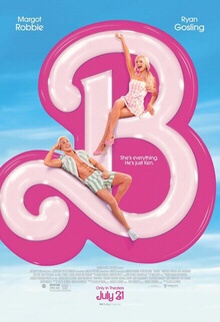
The plot is that Barbieland is a matriarchal utopia where “Stereotypical [blonde, slim, fashion-conscious] Barbie” (Margot Robbie) spends her days eating and drinking pretend food, going to the beach, partying with the other Barbies, and conducting an asexual but still heteronormative relationship with her personal Ken (Ryan Gosling). But one day… shock! Horror! She has flat feet! And cellulite! And thoughts of death!
She seeks advice from “Weird Barbie” (Kate McKinnon), a Delphic oracle whose child played with her too hard so now she’s got punk hair and does the splits a lot. She explains the nature and cosmology of Barbieland, sort of, before sending Barbie on a quest to Los Angeles to learn the truth of why she’s becoming more human. Ken joins her on this journey and hijinks, as they say, ensue.
The plot of this film is a pain to describe because it’s so bitty, disjointed, and overstuffed. A lot of it felt like I was just watching jokes that I’d already seen in the trailer stitched together by the most awkward plotting.
I haven’t even covered America Ferrera as a dissatisfied Mattel employee, Will Ferrell as the toy company’s CEO, Ariana Greenblatt in a deeply annoying role as Ferrera’s sulky and mean-spirited teenage daughter (pro tip: if a child character’s supposed to be a likeable audience surrogate, don’t have another kid introduce her as horrible), and Michael Cera as discontinued “Ken’s buddy” Allen. Or Ken’s whole subplot where he discovers patriarchy and takes over Barbieland.
And that’s the other thing: the satire. To describe it as ham-fisted would be a slight against pig knuckles. At various points the story, such as it is, just stops to allow for characters to pontificate about its themes. I get it, you’re writing for a young audience, but I don’t know, I think that satire’s more effective in the movies when it’s a little more integrated into a narrative. WALL-E (2008), for instance, was an effective environmental parable for kids without needing a lecture series.
There’s also a sense that the “satire” is basically an apologia for Mattel and its Barbie line, which has historically faced charges of encouraging antifeminist ideals of size-zero bodies and interests narrowed to boys and consumer goods. Yes, Barbie can be whatever she wants to be, but her defining image is of a babe with an hourglass figure and a greater interest in lip gloss than career goals.
Still, the film does impart a good message that may well be special and empowering to girls, so my lack of response is really irrelevant. The central performances are all excellent. Gosling is a standout for the comedic chops that he brings to Ken, making him simultaneously pathetic and sweet.
My favourite appearances, though, were relatively marginal ones: 91-year-old costume designer Ann Roth in one scene at a bus stop, and Rhea Perlman in a scene-stealing role as Barbie’s creator Ruth Handler. It was lovely seeing Perlman again; she should be in movies more often.
Barbie is helped a lot by its meta humour and camp stylisation. I did like its satire of toxic masculinity (tell a man you’ve never seen The Godfather so he’ll mansplain it to you, one Barbie’s told) and such surreal items as an advert for Depressed Barbie. I just wish that it had really leaned in on the surrealism, or else told a simpler story that invites you to interpret its message a little more.
 I Just Saw
Leave a comment