
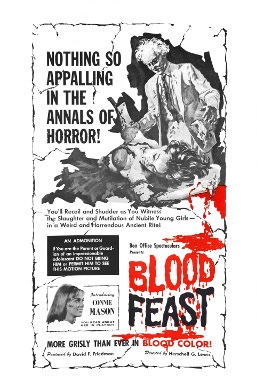
Described as the worst horror film he’s ever seen by Stephen King, Blood Feast is a notorious 1963 splatter film by celebrated schlockmeister and “godfather of gore” Herschell Gordon Lewis. I say “celebrated”. He’s discussed and referenced fondly by artists who cut their teeth on the sort of pulp trash that Lewis made his name with. John Waters, for instance, whose Serial Mom (1994) is why I’m aware of Blood Feast since it plays in the background of at least one scene.
Lewis in truth was a journeyman hack who worked at a much lower level of artistry than many of those he inspired. In the hierarchy of schlockmeisters, he’s above a total (if endearing) incompetent like Ed Wood but below a genuinely interesting and stylish satirist like Waters.
Amusingly, Blood Feast was inspired by Lewis’ feeling that Alfred Hitchcock’s Psycho (1960) hadn’t gone far enough in depicting its murders, which is a bit like me saying that Leonardo da Vinci didn’t do a good enough job with the Mona Lisa, so now I’m going to make my version.
The story is that a mad Egyptian caterer, Fuad Ramses (Mal Arnold), is killing girls around Miami to use in a “blood feast” designed to resurrect the goddess Ishtar. Playboy model Connie Mason plays a student of Egyptology whose unwitting mother (Lyn Bolton) hires Ramses to cater her daughter’s birthday party, while William Kerwln (credited as “Thomas Wood” for some reason) plays a detective on the killer’s trail and who’s also romancing Mason.
The film contains little in the way of even basic plotting, performance, and motivation, at least of a kind that would be convincing to anyone. It’s about on the level of a school play. The thing that you have to remember about early splatter films and other B-movie schlock of their ilk is that they weren’t made to be entertaining in the same fashion as modern horror, with relentless pacing and stylisation.
A film like Blood Feast exists purely for its then shocking gore and maybe some fetish material, like an extended scene of Arnold whipping a young woman. The dialogue scenes in between are just passage work almost written to be tedious because you’re not really supposed to be paying attention during those scenes, but rather necking your date at the drive-in.
That’s why music is so omnipresent and melodramatic during certain scenes. The soundtrack serves as a guide to when you should have your eyes on the screen, heightening during scenes where violence is imminent before dying away when characters have to get on with the boring business of establishing the plot.
The gore is amusingly grotesque, lit up in bright red paint and offal, including a sheep’s tongue. The ridiculously bad acting and dialogue also make this a fun movie to watch and riff on with friends. Just don’t expect something that you could watch by yourself without feeling the urge to scroll through your phone.


 I Just Saw
Leave a comment