
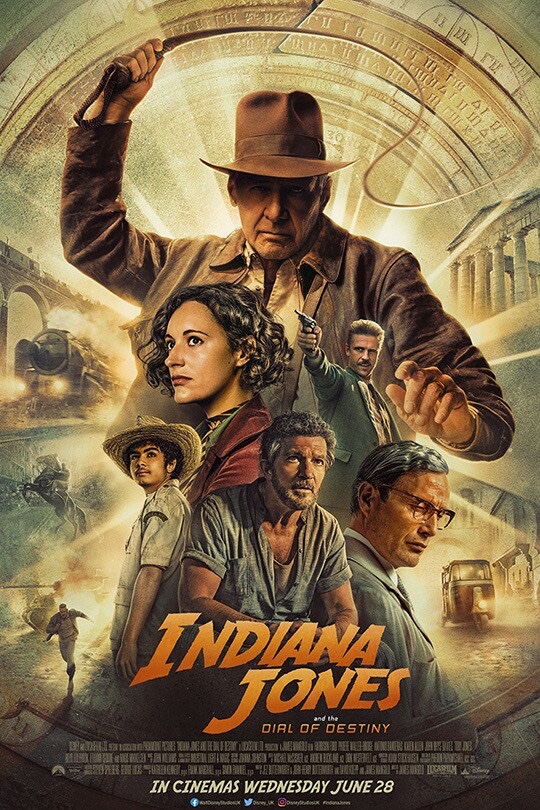
I just saw Indiana Jones and the Dial of Destiny, and it was an enjoyable if somewhat forgettable coda to the franchise. It’s been getting the usual sneering reviews from critics who must think it a sign of their cine-literacy to hold their noses when passing pulp trash, but it’s a watchable piece of hokum with some neat action scenes and some rather lovely characterisation for Indie. My smell test for films like this tends to be “Could Matt Groening’s Futurama have done the same plot better in twenty minutes and with funnier jokes?” I’m not sure it passes that test, but I was never really bored and settled into its comfortable groove.
Undoubtedly the best sequence from a pure storytelling standpoint is the prologue, where a de-aged Harrison Ford in 1945 tries with Toby Jones to snatch back half of Archimedes’ dial from the Nazis. The dial has the power to detect “fissures in time” that can transport you backwards.
This means that when 1969 rolls around Jürgen Voller (Mads Mikkelsen), a Nazi scientist brought to America to assist with the moon landing, is intent on retrieving it so that he can go back and help the Nazis win World War II. Indie, meanwhile, is retiring as a professor and living a lonely life in his apartment until his goddaughter Helena (Phoebe Waller-Bridge) drags him into the fight for the dial.
This is the first Indie film since Kingdom of the Crystal Skull (2008). Crystal Skull wasn’t anything like as bad as years of snarky internet reviews and ingrate fanboys, mad that they’re not having the same experience they did when they were nine, would have you believe. It was a perfectly adequate piece of pulp fiction with some good gruesome moments, amusing pseudo-science, and colourful villains. Let down by some bad CGI and ropey plotting, but the hate that it receives – leading to an infamous South Park joke where it’s depicted as Lucas and Spielberg literally raping Indie – was undeserved in the extreme.
Forgive me for going on a tangent, but it’s comparable to the revisionist history that says that the Star Wars prequels were unmitigated disasters. I’m not going to pretend that they were even close to as good as the original trilogy, but they received good reviews from a fair amount of critics and were serviceable space operas, as evidenced by the fact that if you show them to children they’ll almost certainly enjoy them.
(Yes, even Jar Jar; who believe it or not wasn’t designed with thirty/forty-something men in mind. Not to be snarky myself, but if you want adult entertainment, watch an adult film. So to speak. Or, God forbid, read a book.) They’re preferable to the Disney-fied sequels that seem to have been made primarily to fill out their streaming service, more soap than space opera.
Dial of Destiny likewise is more about a safe consumer transaction than risky and energetic multiplex entertainment. Even the title reflects a carefully neutered marketing aesthetic, at pains to not refer to any particular time or culture that might get it accused of insensitivity. What I find interesting is that critics are saying that it’s “at least” better than Crystal Skull, which indicates to me that they prefer the safe and generic approach employed here to genuine risk-taking by a team invested in the cause of authentic pulp thrills.
Mikkelsen is good as Voller, but he could play this type of Eurotrash villain in his sleep and gives essentially the same performance that he did in Casino Royale (2006). The character of Voller is still underwritten, and feels faintly moronic at times, like when he doesn’t seem to understand continental drift.
Admittedly I wouldn’t have predicted what Voller fails to either, but I’m not a top Nazi scientist who was drafted to assist with the American moon landing. With guys like this at the top, no wonder the Nazis were obsessed with occult nonsense. He’s by far the least interesting of Indie’s rogue’s gallery of villains, although he does have one good scene in 1969 when he tries to intimidate a black waiter. If the film had expanded on this and wasn’t afraid to present the true evil of a Nazi’s motivations, he might have been more distinctive.
Phoebe Waller-Bridge is good as Helena because she’s a good actress. I’m not sure why this one British writer and comedienne needs to keep showing up in action franchises, but whatever, she’s fine. Less fine is the child actor playing what is basically the Short Round role from Temple of Doom (1984), here a Moroccan pickpocket who assists Waller-Bridge. His performance is genuinely awful, but since he’s a child and not the star that’s the director’s fault. Some directors are better than others at directing children, and there are plenty that get great performances from them.
Dial of Destiny is in the end a pretty good adventure film. I was never bored, and when the film approaches its climax was even excited with a little of the same feeling that I had when watching the old films. Where will the characters end up when the dial of destiny is spun? It’s a bit like when the Star Trek crew approached the anomaly in no V: The Final Frontier (1989), and somehow less nonsensical than William Shatner’s film was when you find out where it’s leading. So while this one is in my view the least of the Indie films, it’s a nice little epilogue. It’s also sort of moving to see an elderly Harrison Ford back in the hat. This will always be a durable pulp franchise with a lot of iconic elements.
 I Just Saw
Leave a comment