
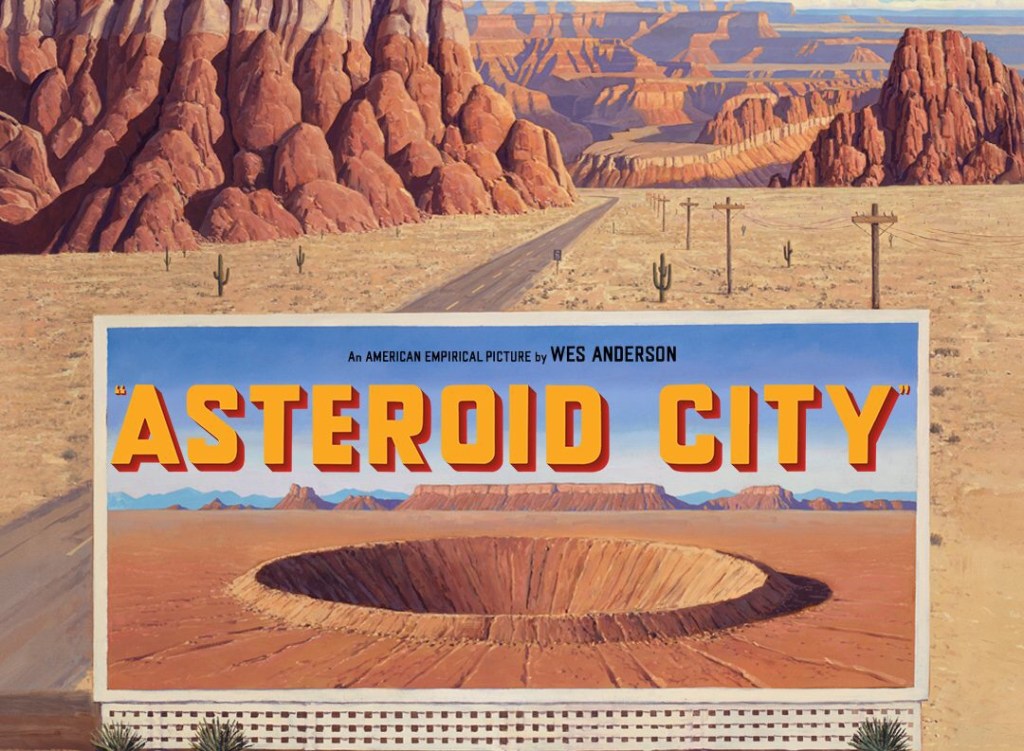
I just saw Asteroid City by Wes Anderson and it was great. It took a little while to win me over and it’s possibly too mannered and esoteric to be widely beloved, but it tells a very simple story with a simple message at its core and is one of the sweetest, sunniest comedies to emerge in a while.
It feels almost like a deliberate counterpoint tonally to Christopher Nolan’s upcoming Oppenheimer film, taking the elements of a story about government coverups and intelligence at a remote army base where bombs are tested, and translating them into a tale of love, and grief, and moving right along. It’s a film that I’ll happily sit through again, which is rare for recent comedies.
The plot is split into two halves, one shot in black-and-white and the other deliberately oversaturated colour. The B&W scenes are about a 1950s television broadcast, hosted by Bryan Cranston, documenting the production of a play called Asteroid City that’s the work of a famous American playwright (Edward Norton).
The colour scenes are that play and follow various characters as they assemble at the titular Death Valley settlement for a stargazers’ convention, where prizes are awarded to junior scientists of note. These characters include Augie (Jason Schwartzman), a widowed war photographer whose teenage son is one of the scientists, Tom Hanks as his father-in-law and Scarlett Johansson as a starlet with whom Augie develops a flirtation.
At first, all of this left me with a feeling of “Okay, this is clever, but I’d like there to be a plot at some point.” As the film trundled along much like the freight train of its theme song, however, I started to invest in it more and more.
It reminds me of something Virginia Woolf said about Jane Austen’s novels, that you have to look for passions and strong emotions rather than having them handed to you. Anderson is a somewhat Austenian writer in that his work focuses on comedy-of-manners, and in Asteroid City especially you have to search the margins for the strong emotions, while the centre is crammed with arch dialogue.
When a woman alludes to her history with violent men, for example, or a character in the B&W (or “real”) world is implied to be gay, not a social advantage in the 1950s. Another filmmaker could have taken these moments and made them the literal focus.
In other words, he or she could have made a tragedy instead of a comedy. In this respect, I’m reminded of a 2004 Woody Allen film, Melinda and Melinda, which tells two stories about the same woman who interrupts a dinner party with a half-baked suicide attempt.
The difference is that one story is told as a tragedy, the other as a comedy. One has a happy ending, the other doesn’t.
Wes Anderson goes for comedy, more so than in any other film by him I’ve seen, and the story’s metafictional telling distances it so far from realism that it might be a baffling bore to many, even Anderson fans. But I liked it.
Augie’s story is the thread that holds it all together, while the excursions into science fiction with an asteroid and interstellar life provide a thematic lynchpin. The sci-fi stuff is straight out of Monty Python by way of The Clangers and is so cartoonish that it bypasses suspension of disbelief to enter a realm of demented authenticity all its own.
It’s strange, therefore it is. In the end, the film’s purpose and intent are summed up by its patron song, “Freight Train” by Nancy Whiskey and Chas McDevitt.
The song is upbeat and cheerful, but if you listen to its lyrics it’s surprisingly grim. “Got no future, got no hope / Just nothin’ but the rope …”
That mix of dark words and sunny vocals is Asteroid City in a nutshell. Its Death Valley is straight out of a cowboy cartoon, it’s studded with silly jokes and cheesy romance, and yet all of that’s atop a tale of existential grief.
Thematically, what it’s ultimately about is dreams, and how we use tools like humour, romance, and even self-deceit to get by. Even larks and katydids are supposed by some to dream, to quote Shirley Jackson; only that which is insane doesn’t dream.
 I Just Saw
Leave a comment