
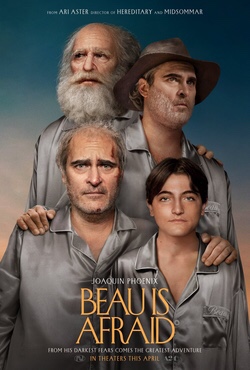
I just saw Beau is Afraid and it was overlong, intriguing, infuriating, and kind of unique. It’s possible to see it as a gigantic self-indulgence with little respect for the audience’s time and the same contempt for them that you see in a lot of contemporary art. And it is that. (There were walkouts in my screening.) But it’s also a lot of other things. It’s the third film by Ari Aster, the first two having been horror films, Hereditary (2018) and Midsommar (2019).
I have mixed feelings about his films. They all have very strong elements but never quite come together as convincing wholes. Hereditary, for example, had powerful scenes of familial trauma and a great “unbalanced matriarch” performance by Toni Collette, but is in tension with and ultimately neutered by a hammy “Satanic panic” plot. Midsommar’s “evil pagans” plot, meanwhile, grows even more diffuse until it’s just reiterating its main points over and over again in a parade of symbols.
And thus we arrive at Beau is Afraid, which kind of eschews coherent plotting entirely and focuses on symbology for three hours, tied together by the thinnest of plots. If you’ve followed Aster’s work at all it’s obvious, I think, that this is the type of thing that he wanted to make all along and that he only made genre films out of necessity. (He pitched Midsommar as a slasher film but then went on record as saying that he didn’t care about the cultic aspect.)
Beau is Afraid is a surrealist black dramedy about the titular man, Beau Wasserman (Joaquin Phoenix), as he goes on a nightmarish odyssey sparked by the death of his mother, Mona (Patti LuPone as an old woman, Zoe Lister-Jones as a young). The story starts in an urban hellscape where slack-wits egg on suicides, a nude serial killer is unimpeded by incompetent police, and everyone’s just waiting for a chance to strip you of everything you own.
From there the story spreads out to encompass other places and problems for Beau, a neurotic and passive milquetoast. These include the home of a middle-class family and a magical wood that seems to be referencing the forest of Arden in Shakespeare’s As You Like It.
The film is three hours long and its sheer indulgence does get to be grating. There’s an entire, long stretch of the film with Nathan Lane as a surgeon living with his wife and child in a suburban madhouse that does not need to be there. It serves no strong purpose other than to provide a character who ends up chasing Beau from scene to scene, and I guess a secular familial counterpoint to the Wassermans. It was nice to see Lane, brilliant as ever, in a film again, but that whole subplot has “please remove before next draft” written all over it.
Phoenix gives a typically great performance as a pathological nebbish. The whole first act of the film is a dark and funny dramatisation of how people think when suffering from an anxiety disorder.
It starts with a simple premise – a man due to visit his mother feels nervous and guilty about the upcoming trip – and then brings about every worst possible outcome that could run through his head. A psychotic neighbour makes him miss his morning alarm, his credit card doesn’t work, his keys are stolen, etc. It’s like Franz Kafka’s The Trial but with the bureaucracy inside the man’s head and all his irrational fears coming true.
Thematically, the film also deals with sexual dysfunction and the long-term effects of emotional abuse. There’s been some slightly antisemitic commentary about this film, one broadsheet critic sneering that Aster’s just another neurotic Jew with a hectoring mother. (Funny how abusive mothers are only a tired cliche when they’re Jewish.)
That said, the film does in part satirise this trope, riffing on the emasculating Jewish mother recognisable from such texts as Portnoy’s Complaint by Philip Roth. This is a very funny film at times, with a sense of humour as black as night, macabre and poised often on the extreme edge of awkwardness. (The third act includes one of the most excruciating sex scenes in a while.)
I also detected Holocaust themes at certain points, though I suspect that that might be reaching on my part. A sequence in the forest of Arden describing lost families and social rejection, coupled with Beau’s curious lack of relatives other than his mother and constant attire of grey pyjamas, evoked such themes in my mind. How much those were intended by Aster, however, I wouldn’t like to guess.
Other more Freudian and self-excoriating themes are more obvious. The Nathan Lane subplot promises a satire of middle-class American values that never materialises.
Ultimately, Beau is Afraid is infuriatingly overlong and up its own backside, with a plot that, once you strip away its endless stylistic accoutrements, is derivative to the point of caricature. Story-wise, there’s nothing here that’s not been done with greater depth and nuance elsewhere. I was almost lulled into feeling deeply moved by the film at one point, but really I was just responding to the appearance of one of my all-time favourite love songs on the soundtrack, “Everything I Own” by Bread.
And yet, I’m glad I saw it. It genuinely was kind of moving at times. Its visual style was fun, its jokes funny, and its eccentricities at least intriguing. It’s the best of Aster’s work, in my opinion. Its strongest thread is the emotional abuse plot, the story of a quasi-incestuous relationship between a boy and the type of mother whose abuse goes unnoticed because she’s handsome, clever, and rich. If Aster had tried to make a fully rounded character of that matriarchal figure, instead of just a caricature, this could have been a great film. But then you could say similar things about all three of his films.
 I Just Saw
Leave a comment