
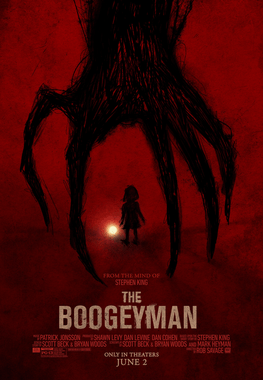
I just saw The Boogeyman and surprise surprise, it was crap. I kind of knew that it’d be mediocre going in just based on its trailers, and certain details as to its inspiration, but went anyway because it’s “from the mind of Stephen King”. I didn’t expect it, however, to be as godawful as it was. I didn’t think that Unwelcome would have a challenger for the worst horror film of 2023, but I don’t think I’ve come closer to walking out of a film than in this one for a long time.
I’ll say this for Unwelcome: it wasn’t boring. At a certain point in The Boogeyman, I started staring at the fire exit, because the green neon sign with the man running for the door held more story and character engagement than what I was seeing on screen. Before I went in I walked into the wrong screening room and saw Guardians of the Galaxy Vol 3 about two-thirds through. Sticking around to watch the last third of that movie again would have been a better entertainment option, in retrospect.
But enough of my invective. To go back to the beginning, The Boogeyman is based on a short story from Stephen King’s 1978 anthology Night Shift, his first collection. It’s a good collection, though I’m not sure how many great films its stories have inspired. Children of the Corn (1984)? More of a camp classic. “Trucks” inspired Maximum Overdrive (1986), the only film that King’s ever directed and which he accurately called a “moron movie”. “The Mangler” was made into a hilariously gruesome Tobe Hooper abortion of the same name (1995).
The problem is that the stories are from early in his career and so (for the most part) are highly conceptual, meaning less based on things like rich characterisation and theme than the technical execution of picturesque hooks. (A haunted laundry machine, a townful of evil children, etcetera.) To make them into films, therefore, you need to work hard to build a story that’ll sustain 90 or however many minutes.
It’s no surprise that the best bit in The Boogeyman is a direct lift (I think, correct me if I’m wrong) from the source material. A small child has a therapy session in which the therapist activates a flashing red light box to deal with her fear of the dark. The little girl looks up as the room vanishes and is then revealed again, red-hued, the therapist’s kind and smiling face looking briefly eerie as it hovers above.
Of course, the film then ruins the moment with its usual slam-bang-and-CGI nonsense, but for a brief moment, something vaguely interesting escapes being brutally stomped by the filmmakers.
The plot is that widowed therapist Will (Chris Messina) and his daughters, teenager Sadie (Sophie Thatcher) and elementary schooler Sawyer (Vivien Lyra Blair), are grieving their matriarch when a boogeyman attaches itself to the house via the suicide of a man who’d come to the father for help.
The prologue is blandly filmed but kind of intriguing just because it’s not afraid to “kill the kid”, so to speak. That’s rare these days. It’s no longer the 1980s when The Blob (1988) could fling a little boy’s flesh-stripped bones at his babysitter. After that, though, the film started annoying me straight away just by its obvious refusal/inability to set up a halfway convincing world.
Let’s look at the inciting incident, the man’s suicide. Don’t therapists have offices away from their homes for precisely this reason? They deal with troubled people, and the film even highlights how inappropriate the dad’s office arrangements are by having him notice his younger daughter’s shadow underneath his door as he’s counselling a patient.
‘Don’t mind the noise, that’s just my 9-year-old being a cheeky monkey and listening in. Anyway, when did your memories of the incest first start resurfacing?’ The US comic Sarah Silverman recalled going to a therapist as a child only to learn that he’d hung himself in his office. That guy was more responsible about his workspace and client well-being than Will. Will comes across as so emotionally unintelligent, and just vacant as a human being, that he ends an argument with his traumatised daughter by just blandly abandoning his prior conviction and walking away.
Something that also doesn’t happen in real life? A woman allowed to live in a rundown house on a packed suburban street and fire a shotgun periodically. (What she does for food or rent or why the bank haven’t foreclosed I can’t say.) Yet that happens here. You picture a neighbour glancing up from his paper when another blast goes off. ‘Did you hear that, darling? Tell George to come inside or she’ll be spraying him up the wall, mad cow.’
None of the characters are written well. The film feels the need to contrive drama for Sadie, so it has a girl at school bully her for having a dead mum. Okay. No doubt some 17/18-year-old girls are this psychopathic.
But surely they’re not then invited to their victim’s home for a party, with a bunch of other girls who recognise her bullying as wrong (and aren’t afraid to say so) but still stand by her? I don’t know, as I write this I realise that another film could probably have made this believable, but this is The Boogeyman. The last guy who suggested better character writing probably got put through a wall.
The larger part of the film is just Gen Z rattle-and-scream garbage. It’s a film that’s about nothing, and not in a good way. It has no plot, no characters, no themes. Not really.
I mean, it pretends to. People are saying things and they have names and the barest minimum of backstory. They look sad and their world is drenched in a faux-melancholic grey hue. Certain elements are reincorporated in a “Chekhov’s gun” sense. But it’s all just icing. (And not even tasty Betty Crocker icing. More like Tesco Value.) It belongs on the back end of a streaming service. The boogeyman itself is indistinguishable from a hundred other CGI demons and has no real motivation. It doesn’t even work as a metaphor for grief, a la The Babadook (2014), although the filmmakers probably think it does.
The only thing that this film is really about is its jump scares. Here’s an idea for such a movie: a family are haunted by a mysterious presence in their home. Doors slam shut. Things fall off shelves. The usual thing. They start slowly going mad, but then they realise what’s been going on… a film crew have set themselves up in the walls and started deliberately scaring them to make a new movie on the cheap.
Stray observation: The song that starts the end credits doesn’t fit tonally. You can see why they chose it. It’s a trend now for horror films to end with classic rock/pop songs. But that only works when the film that we’ve just seen had a sense of ironic humour/awareness about itself. Such as when “Be My Baby” rounds off Barbarian’s (2022) inbreeding plot, or “Bad Case of Loving You” closes X’s (2022) story of sexual jealousy. The Boogeyman should have ended with “Here Comes the Boogeyman” by Henry Hall. They couldn’t even get that right.
 I Just Saw
Leave a comment