
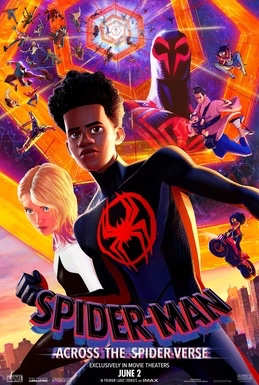
I just saw Spider-Man: Across the Spider-Verse and it was really good. The art style and soundtrack are the best things about it, feeling integrated into the story at a level that’s rare for superhero films. For once one of these projects feels like an actual comic book film, which apart from Doctor Strange in the Multiverse of Madness and maybe Thor: Love & Thunder has been all too rare for movies with the now ubiquitous Marvel studios logo upfront. Perhaps tied in with the audiovisual style, it also develops its theme to an impressive degree. It’s not a massively complex or daring story, of course, but it’s intelligently written and fully realised, not just a one-ply tissue of nonsense better fit for a streaming service.
The story is that 15-year-old Miles Morales (Shameik Moore) is forced to balance his new responsibilities as a superhero against everyday commitments, as per all Spider-Man stories, when he runs into the Spot (Jason Schwartzman), a Rorschach-esque villain whose ink blots open up inter-dimensional black holes. Also chasing the Spot is Gwen Stacy (Hailee Steinfeld), a Spider-Woman who’s been recruited by a secret society of Spider-People tasked with maintaining balance between the multiple universes. But their sense of preordained destiny is about to have disturbing implications for their morals…
The film’s freewheeling visual style is reminiscent of The Lego Movie, which it cites at one point. This is a film that’s more about storytelling than story, and while its frenetic pace might prove too busy for some (there were times when I struggled to register dialogue between the near-constant action scenes), it’s all of a style that serves the film well and makes it an engaging experience for this sort of thing.
The plot has its longueurs, which is fancy talk for boring bits. I’d have edited down the personal life stuff with Morales, suggesting more than showing it, and the Spot is an oddly underwhelming villain. His backstory didn’t make a lot of sense to me (why would scientists just ridicule his new nature like schoolchildren rather than study it?) and felt oddly mean-spirited. He starts as a guy whose criminality is relatively mild and committed out of desperation, yet he’s treated as nothing more than a punching bag.
But as the story progressed this became less of a problem just because it grew clear that he’s not the real villain at all. The secret society at the heart of the film is where the real drama lies; it feels like the Jedi temple from the Star Wars prequels, if those films were aware that the Jedi are a creepy and cultish group whose existence depends on dehumanising its disciples from early childhood. The story gets genuinely intriguing here, with its Calvinist implications about destiny (certain things are pre-ordained, including evil things) and how good and evil aren’t necessarily fixed attributes. Sometimes another version of yourself may well be a supervillain rather than a hero.
 I Just Saw
Leave a comment