Here’s a question: what city do the Saw films take place in? According to Google, it’s New Jersey, but I ask because, more than how he makes the traps, I’m wondering how The Jigsaw Killer finds the real estate necessary to enact his schemes while police never seem to be in the right place at the right time.
Surely competent police work would have led the boys in blue to the compound where the first film played out. Even if we assume that Dr Gordon didn’t make it to the cops, his wife and child would have, and Donald Glover’s cop had former colleagues who could have traced him. SOMEONE must have been on the case here.
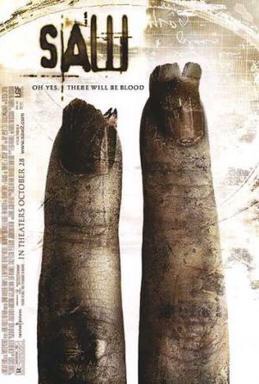
Never mind. Saw II, released a year after Saw and the first sequel in an annual series that would last for an incredible seven films (before taking a six-year hiatus that ended with 2017’s Jigsaw), sees Detective Matthews (Donnie Wahlberg) investigate further murders by The Jigsaw Killer. Just when he seems to have captured him, he finds in his lair a video feed from a house where Matthews’ juvenile son Daniel (Eric Knudsen) is trapped with several adults.
These include Xavier (Franky G), Jonas (Glenn Plummer), Addison (Emmanuelle Vaugier), Laura (Beverley Mitchell), and Amanda (Shawnee Smith). The latter of whom seems to have played the game before…
The concept behind this one isn’t bad at all. Put a group of volatile and potentially criminal personalities in a funhouse packed with booby traps and so force them to either overcome their antisocial impulses or die. None of the characters in the house besides maybe Amanda and Daniel are developed enough for this to work, however. They’re mostly just cliches and canon fodder, although I did somewhat like Jonas and Laura; Plummer and Mitchell’s respective performances brought a certain intelligence and vulnerability to them.
The biggest problem with the execution of Saw II’s premise, however, and the thing that sinks the film so much more than any issues with bland supporting roles or ludicrous plotting, is a gash in the script shaped not like a jigsaw piece but Donnie Wahlberg. Put simply, his character is a pathetic, unlikeable moron.
Even that’s giving the characterisation too much credit, though, since even in Detective Matthews’ unlikeability, he’s not well-drawn or motivated enough to resemble any sort of useful protagonist. Part of Jigsaw’s game this time around involves this man’s self-image, how he’s perceived by his son and presumably colleagues, yet he starts the film with his son hating him and at no point conveys that he’s a competent or even well-intentioned policeman.
So what’s his deal? Who knows? He fills the Dr Gordon/Cary Elwes role from the original, but Dr Gordon was an intelligent and reasonably well-meaning guy. He was flawed, but his flaws came down to relatable things like a lack of appreciation for his blessings and sexual temptation. It’s clear that Saw II is trying to do the same sort of thing with Matthews, but has no clue how. It doesn’t help that he’s written with a stupid macho bluster that Wahlberg leans into.
It’s clear that to work dramatically Saw II needed radical restructuring at a script level. It should have opened (after the prologue) inside the house and spent time developing the characters while interspersing those scenes with Detective Matthews and co as they find, capture, and interrogate Jigsaw, drip-feeding information so that we don’t find out about Matthews and Daniel’s relationship until that’s revealed by a photograph in one scene. (This would require some serious rejiggering of when the live feed from Jigsaw’s lair is revealed, but would I feel be worth that.)
Furthermore, by seeing Matthews function solely as a detective investigating a case before unseemly facets of his past are revealed, we’d relate to him on some level and the revelations would be surprising. Although Daniel should really have been the protagonist anyway, with the house scenes taking the majority of screen time.
I have to blame director Darren Lynn Bousman for Saw II’s self-defeating story structure and obnoxious characters. Leigh Whannell of the original is credited as co-writer, but Bousman is the sole director and Saw II is based on an original script that he wrote (called The Desperate) before being told of its resemblance to Saw and roped into making a sequel.
What Whannell and director James Wan understood about machine-like plotting in Saw is gone here, which isn’t to say that Saw was a masterpiece. It was a wind-up toy that existed to jerk its simple characters around on strings and show you scenes in a non-linear fashion for the sake of the puzzle. That was its charm. It wasn’t profound, but it was smart and engaging. Saw II tries for that sort of thing, but unlike its antagonist, it’s not very good at rigging up the puzzle.
What I enjoyed about the film was Tobin Bell and the funhouse scenes, which are engaging just for what they are. I do like certain of the twists and turns in the house, including the excruciating needle pit in one room and a surprising callback to the first Saw near the end. Bell stands out as the greatest actor here. With his pursed lips, gravelly tone, and half-closed eyes, he’s more like a depraved trickster god than a realistic serial killer. He brings a fully realised personality to the antagonist and the film benefits massively by foregrounding him.
The other elements that one demands from a Saw film are also well-done. It has fun traps, such as a Faraday cage overseen by the Jigsaw puppet, and there is of course a Closing Twist. My favourite bit of dialogue, meanwhile, was when Jigsaw makes an Easter egg-esque reference to a classic Wes Craven film while directing a police escort. The film as a whole initiates the bizarre tone that would become a Saw franchise staple, a cross between daytime soap (particularly in its acting and plotting) and splatterpunk.
Saw II is entertaining and like a lot of horror sequels in that it expands upon a story that should have remained unserialised by upping its scale, so instead of a room you have a house, more players, more police, etcetera. It’s badly let down by an awful protagonist, but still worth checking out if you like the first film.
 I Just Saw
Leave a comment