
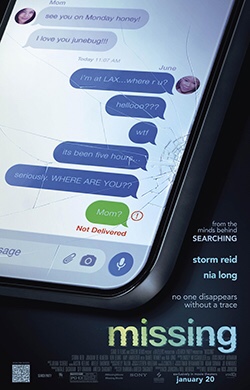
I just saw Missing, the new “found footage” thriller, on a whim and it was pretty good. I was about to reflect that “found footage” is really an outdated term for this genre, since the footage isn’t really supposed to be “found” (a la “this was the campers’ video diary during their stay in the scary woods”) anymore, but on looking the film up I see that a more relevant term has been coined: “screenlife”, or “computer screen film”. This genre came about in the 2010s, although examples have been traced back to as early as 2000 and 2005.
Others which use computer elements as part of their storytelling and presentation include 2004’s The Card Player, one of Italian horror maestro Dario Argento’s worst films, about a serial killer who decides his victims’ fate based on rounds of internet poker, and 2002’s FeardotCom, a box office bomb dealing with an evil website. (So Twitter, basically.)
The genre in its present form, though, where the entire story is told through a computer screen, had its most nascent stage in the early 2010s. Those movies were mostly garbage, flitting between a paranoid PSA by an auteur clueless about both the internet and young people (the immortal Megan is Missing, 2011) and teen slasher nonsense (the Unfriended films, 2014 and 2018 for the sequel, Dark Web).
There was even an attempt at a comedy film, 2012’s Project X, also aimed at teenagers and a box office success, though loathed by critics for its frat boy antics and controversial for supposedly encouraging kids to throw large-scale house parties when their parents aren’t around. (I was 21 at the time and vaguely recall the panic, such as an incident where a girl threw a bash that wound up destroying her mother’s wedding dress.)
In the same year as Dark Web, however, we got a really good film in the screenlife genre: Searching. (Also notable as the first mainstream Hollywood thriller to be opened by an Asian-American lead.) With this entry, the genre seemed to have finally found the best broader genre to cross-pollinate with: the mystery. This may indeed be a future avenue for detective thrillers on the big screen. It’s been harder to tell those stories with the advent of tech that nullifies many detective plots and clueing, but screenlife allows filmmakers to integrate that tech into the story, showing how a mystery is solved in the modern world in real time.
This brings us to Missing, the plot of which sees eighteen-year-old June (Storm Reid) prepare for a weekend alone as her mother Grace (black cinema veteran Nia Long) jets off to Colombia with her new beau, Kevin (Ken Leung). But when she doesn’t return, June finds herself trying to solve a mystery that has serious implications for both past and present…
The story is told almost entirely through June’s laptop screen, with webcam footage capturing her actions and various sites and messaging services pushing events forward. The entire framing device is slickly and cleverly done, with attention paid to the mechanics of it, cramming authentic details into the frame as well as some knowing humour. The mystery is involving and well-structured, with hints that you can follow to try and solve it. There are likeable characters; Storm Reid comes across as a genuinely smart teenager, and Long and Leung are effective in roles where you can’t quite be sure of their motives. There’s also a couple of good heart-in-the-mouth scares.
On the downside, as the story’s secrets are revealed it becomes less interesting. Without giving anything away, it turns into a domestic thriller of the type that was popular in the 1980s and ‘90s – Sleeping with the Enemy (1991), Deceived (1991) – and these days tends to be associated with daytime TV movies with titles like It Was Him or Us (1995), Sins of the Mother (1991; that must have been a really big year for these movies…), and Please, Kevin, Not in the Face (okay, that last one was from American Dad!).
If the film had something to say about domestic violence or felt like it was derived from real cases that would justify the theme, but it’s really just a straightforward thriller, right down to the questionable character decisions in the last act. Again, cleverly told and with real ingenuity in how it’s structured and presented, but a well-prepared hot dog is still a hot dog.
Secondly, this might just be me putting on my Helen Lovejoy hat, but is it really wise to encourage teenagers to play Nancy Drew in missing persons cases, as this film kind of does with June conducting her own investigation against police advice? The film does flirt with the theme of amateur overreach in scenes of podcasters and influencers forwarding their own theories to our heroine’s distress, but doesn’t explore this. I don’t know, I’m sure that most if not all young people watching this movie are smart enough to know that you shouldn’t play girl detective in real life, and I get why Missing chose this plot as it’s a neat inversion of Searching (about a father searching for his child).
There’s just something weird to me about, for example, a scene where a young girl in what looks like her PJs crawls around a murder scene which for all she knows involves Colombian drug cartels. That’s how you get trafficked, or end up starring in one of those grisly execution videos that become urban legends.
Still, the film remains an effective thriller in its basic visual craft. I really liked how it got around the need for a conclusive confrontation with police while sticking to the screenlife format. It’s worth a watch if you enjoy crime thrillers.
 I Just Saw
Leave a comment