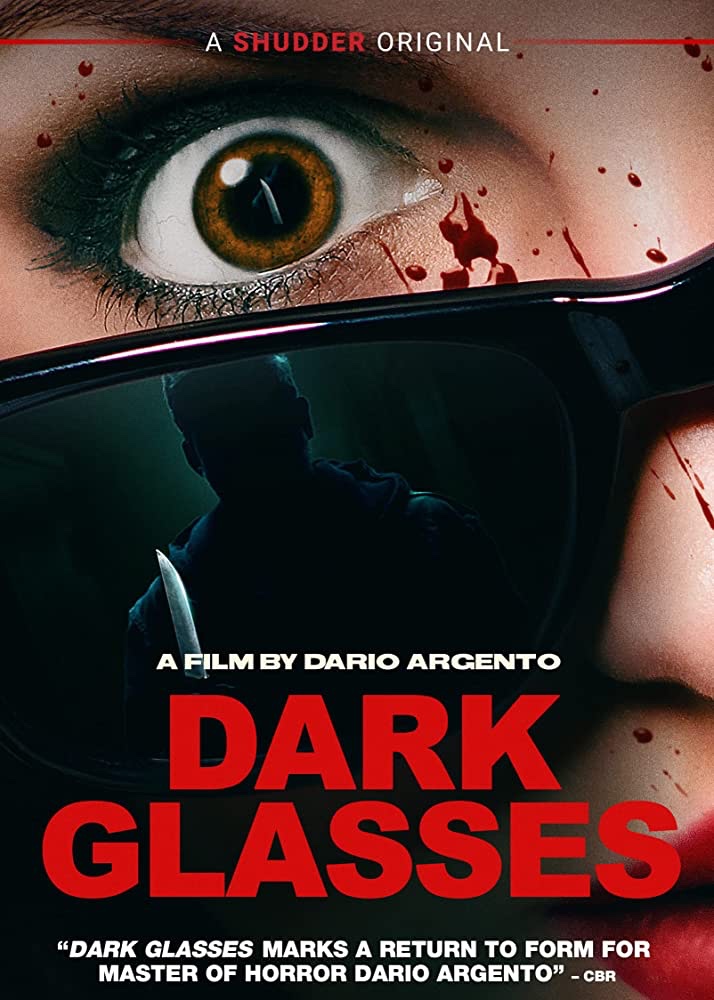
Released both theatrically and to streaming in 2022, Dark Glasses is Italian horror maestro Dario Argento’s first directorial work in 10 years, preceded by 2012’s infamous Cannes Film Festival disaster Dracula 3D. It’s an improvement over some of his more recent work, which isn’t saying much. Dark Glasses is more what you’d expect from a filmmaker past his prime and playing with familiar ideas, by which I mean that it’s not an embarrassing trainwreck like Dracula 3D, Giallo (2009), and The Card Player (2004); it’s more just a lame late entry in the auteur’s catalogue.
The slight improvement might be due to Argento’s return to old themes. Both Giallo and The Card Player were serial killer thrillers of the “giallo” genre, mixing detective plots with gory horror. Dark Glasses, though, feels a little more in line with Argento’s ’70s gialli (the plural of giallo). The former two films came out during the “torture porn” heyday of the 2000s and are unfortunate attempts to capitalise on it. Dark Glasses gives us a stalk ‘n’ slash tale reminiscent of older works in Argento’s oeuvre.
However, here’s the thing: when I say “slight” improvement, I mean slight. The cold open is fantastic, strange and mysterious. A woman joins a crowd of people preparing to watch an eclipse, and two parents tell their child that in ancient times people were afraid during such events that the world was ending. The camera takes in the city as a whole and ends with an image of the moon covering the sun as creepy music plays. This sequence is immediately engaging and sets the tone perfectly.
It’s unfortunate, then, that it isn’t setting anything up in the way of a decent story. The woman from the prologue is introduced to us as Diana (Ilenia Pastorelli) and she becomes the victim of a mad slasher who targets sex workers. Diana is such a woman, and when the killer strikes a car chase ensues, ending when her car strikes another and she’s blinded.
A young Chinese boy, Chin, is left orphaned by the crash, and teams up with Diana as the killer stalks them both. Meanwhile, Dario’s daughter, Asia Argento, shows up as Rita, an assistant to the blind who’s drawn into the mayhem.
The majority of the film is a chase. The killer is revealed to us halfway through, although the film isn’t structured in such a way as to make their identity a surprise.
To discuss what I appreciated, I liked that the protagonist is a sex worker. On the one hand, this is just a cheap way to get bare breasts into the film, but I liked that in a genre where sex workers are often used only as meat for the grinder, one of them is in charge of her fate.
The music is also great and the best part of the film. Argento uses electronica composed by Daft Punk to create that uncanny feeling of weirdness and danger so essential to giallo. The gore is pretty good as well, recalling Tom Savini’s work in Golden Age slashers.
It’s largely restricted to kills at the beginning and end of the film, the first a garotting which got an unintended laugh from me as passers-by essentially just watch a woman die in front of them as if admiring the special effects work. “Well help her then!” I yelled. Admittedly I don’t know the medical procedure for assisting someone whose throat has been opened, but I like to think that I’d least give them a hand to hold in their dying moments.
That pretty much covers the stuff I liked. This is an aggressively “first draft” script, and if I had to provide story notes I’d start by changing the character of Chin. This is a film where people don’t behave like people. I got a lot of unintentional laughs from how bizarrely insensitive characters are, like a doctor who makes Diana aware of her blindness, then abruptly says goodbye.
Or when Diana herself tells a child that their parent has died and says that it’s a bad dream they’ll wake up from. Pretty sure you don’t wake up from “dead mum”, love.
But it gets especially bad in the scenes with Chin because of his young age and how Diana essentially kidnaps him. I suppose the idea was to have a cute bond between the two, but it’s so poorly motivated and executed. The actors don’t make it work; though, really, what actors could with such clankingly terrible dialogue and scenes that just sort of happen as opposed to flowing from one beat to the next?
The killer’s fine, I guess. This might be an unfair criticism that says more about me than the film, though it seemed odd how good-looking and well-groomed they are. Their motivation for terrorising Diana doesn’t make sense, although I suppose it doesn’t need to since they’re crazy, and have the same larger psychosexual and misogynistic motives as serial killers in general.
Based on the motivation given, however, wouldn’t it make more sense for them to be gross and schlubby? At any rate, the killer’s an uninteresting basement dweller, for some reason played by someone you’d expect to see on one of those TV shows about sexy vampires.
I want to be kind to Dario Argento since I love his early films. He’s been cranking out junk for so long, however, that you have to conclude that he’s kind of a hack. Extremely talented, yes, especially at things like music and cinematography and general atmosphere. But it’s been clear since the late ‘90s at least that he’s no longer concerned about churning out sophisticated products.
Imagine how good this film could have been if it followed up on the promise made by its strange and engrossing cold open. Imagine if Dario Argento followed it with a script that he and his fellow writers had bothered to re-draft.
 I Just Saw
Leave a comment