
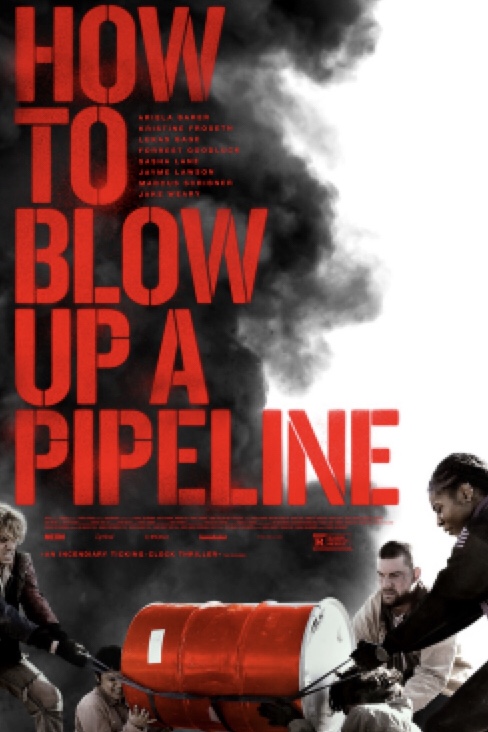
I saw this one as part of my local cinema’s “screen unseen” programme, where they screen a mystery movie that hasn’t yet been given a wide release. I heard some groans from the audience when the title card appeared, though I don’t know what they were expecting and they seemed to enjoy it well enough. This is a taut and well-constructed little thriller, structured like a heist movie in how it alternates present-day action with backstory scenes for each of the characters, as well as using a cross-section of types for the players. These latter include a white working-class Texan, a Native American, and a POC lesbian couple.
Inspired by a 2021 non-fiction book by ecologist Andreas Malm, the story is that a group of eco-terrorists plan to blow up an oil pipeline in the West Texas desert. The plot was set in motion by Xochitl (Ariela Barer), a college dropout raised in the shadow of an oil refinery in Long Beach, CA, the products of which are implied to have both killed her mother and caused her best friend Theo’s (Sasha Lane) terminal leukaemia.
Among their co-conspirators are Dwayne (Jake Weary), a struggling father whose land was seized by eminent domain to build the pipeline; Michael (Forrest Goodluck), a Dakota Native also displaced by industry expansion; Shawn (Marcus Scribner), a filmmaker; and Rowan (Kristine Froseth) and Logan (Lukas Gage), a young couple involved in civil disobedience.
The screenplay is packed with twists and builds a remarkable level of suspense without resorting to extreme violence. Violent things happen, but where another film might have relied on a bloodbath, killing off the characters one by one or having them turn on each other, the story here puts focus on building them up so that you become invested in what happens to them. It sometimes feels like an ‘80s sci-fi or post-apocalypse movie in its gritty soundtrack and cinematography.
Oddly, it reminded me a touch of Southland Tales, the infamous Richard Kelly disaster from 2006. It takes place in a similar milieu of California eco-warriors fighting technocracy in the face of global catastrophe. But where Southland Tales was a gigantic, steaming mess of unresolved plots, bad comedy, pseudo-intellectualism, and baffling characterisations, How to Blow Up a Pipeline is a model of careful and economic writing.
By diversifying the characters’ political, ethnic, sexual, and class identities, it refuses to be pigeonholed as a party political broadcast. It communicates the message that unregulated industry and exploitative sourcing of fossil fuels affect everyone.
I’d have liked some more time spent on developing the characters as a group. We see them fret over one another’s commitment to the cause and reliability, but their time together is limited and we don’t really see them bond outside their pre-existing relationships. The story remains tense and exciting, though. It can probably be enjoyed regardless of political affiliation as a thriller, which is what makes it an effective piece of political art.
 I Just Saw
Leave a comment