
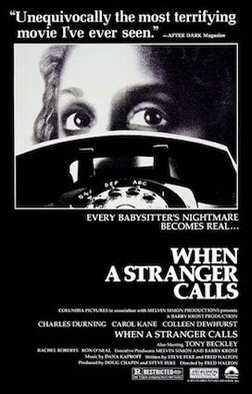
There’s a quote on the poster for When a Stranger Calls that describes it as the most terrifying film the critic’s ever seen. What film they saw I can’t say, but I’d be shocked if it was the same one I did.
We begin with Carol Kane playing a babysitter for a doctor and his wife when (of course) a stranger calls, repeatedly asking if she’s checked on the children. She eventually calls the police, having come to suspect that her nuisance caller is close to home…
The prologue has been regarded as one of the scariest in film history, and if I’d seen it in a theatre in 1979 I might have agreed. The problem is that a lot of films have come and gone in the intervening 44 years, including Wes Craven’s Scream, which referenced it with its own prologue about a young woman home alone at night when a stranger calls.
I’ll just say it: Scream’s version is better. It has a lot more going on both in terms of story and filmmaking. The prologue here is enjoyable enough as a dramatisation of the old urban legend of the call that came from inside the house and has some effective shots, particularly when the protagonist is seen through a window that’s surrounded by pitch black. Shots from around the house seem to reference the ending of John Carpenter’s Halloween, which came out the previous year.
Unfortunately, most of the rest of the film is junk. It’s not the worst of its era, but it’s probably only of interest to fans of this genre and period. Between the prologue and the last twenty minutes are a lot of slow, badly staged scenes with poorly realised characters, including a detective, a random woman, and the killer who was harassing the babysitter. He’s escaped from a mental hospital after seven years’ confinement.
The woman was the funniest to me just because, despite how much screen time she gets, the film doesn’t bother to show us anything about her. Beyond I guess that she lives in a sparsely furnished apartment and drinks at a local bar. (In an unintentionally funny line of dialogue, she says she doesn’t know why she keeps going there.)
Played by an actress (Colleen Dewhurst) who was 55 when the film came out, her only function is to become a target of the killer’s obsession and then be bandied about by the plot. All because she stopped for a drink at a bar. She really does need to stop going there.
I’m normally all for aged-up casting, but if you’re not going to write an actual character it makes more sense to cast a voluptuous twenty-something in a role like this. The slasher genre hadn’t yet been fully codified in 1979, so maybe that explains why there’s a random older woman with no personality where “sorority girl #2” should be.
The film takes almost as little interest in the inner life and background of its killer, Curt Duncan, played by Tony Beckley (who died less than six months after the film’s release). He’s described as an English merchant seaman, but for no real reason other than maybe because Beckley was English and didn’t want to do an accent.
He’s not frightening, just kind of pathetic. He has no real motive for anything he does, which might sound scary but in the film just means that he isn’t drawn well enough. It’s hard to believe that this guy could kill anyone, and it sometimes seems as if the story doesn’t know whether he’s supposed to be a victim of his own insanity or a sadistic psychopath. Beckley does his best and gives the character a certain pathos (which seems to contradict the script’s contention that he ripped two children apart with his bare hands “in cold blood”), but Curt Duncan is not one of the great slashers.
Charles Durning plays the detective and is… fine, I guess. It’s hard to judge the acting because the writing’s so bare-bones. Great acting requires at least something to interpret. What I can say is that none of the acting is embarrassing at all.
Carol Kane gives the film what structure it has. She should have been the protagonist and Dewhurst’s character cut entirely. The filmmakers clearly weren’t all that interested in taking this concept and script to the next level, preferring to shoot it quickly and cheaply. What you get, then, is a few mildly effective scenes, none of which amounts to much of a full film experience.
I became aware of When a Stranger Calls not through Scream but a 1980 “Women in Danger” special of Sneak Previews with Siskel and Ebert, a show hosted by the late film critics Gene Siskel and Roger Ebert. The episode is them complaining about the then-nascent slasher genre, and is a useful resource for identifying examples from that period. I currently have Prom Night and Silent Scream on my docket. Hopefully they justify the late, great Siskel and Ebert’s moral disgust a bit more.
The full episode can be found here:
 I Just Saw
Leave a comment