
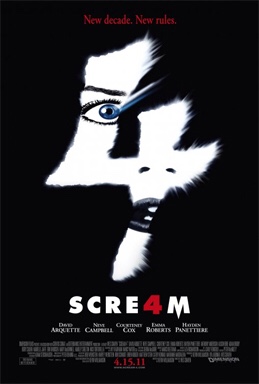
Having recently seen Scream 6, I decided to give 4 a whirl on Prime and somewhat to my surprise had a blast with it. I ignored it when it first came out in 2011 because as much as I love this franchise, at that point I felt that it was done. Sidney Prescott’s trauma was over, as symbolised by that final shot from Scream 3 (released more than a decade prior to diminishing returns) of her looking at an open door and realising that she doesn’t need to be afraid anymore. Let her retire to grow bean sprouts in her garden.
But watching 4 with fresh eyes, it might be my third favourite of the franchise after 1 and 2, although I’d need to watch the underrated 3 again to be sure. Its prologue is certainly one of the cleverest in a series (and genre) for which prologues are an extremely important part of the structure.
4’s exploits the meta element to a degree that borders on the surreal, nesting scenes within each other so that you’re not sure which layer of fiction you’re in. Given that the series is predicated on meta commentary, it’s surprising that it doesn’t pull this type of trick more often.
The plot this time is that series regular and bad-time girl Sidney Prescott (Neve Campbell) has returned to the leafy town of Woodsboro, California to promote a new book about her experiences. There she meets fellow regulars Gail Weathers (Courtney Cox) and her now husband, Dewey Riley (David Arquette). Gail has retired from journalism to try her hand at fiction writing and Dewey is now sheriff.
His deputy is a woman called Hicks, of whom Gail is jealous and who basically serves the same function that Dewey did in the original Scream, as the well-intentioned bumbler. Naturally, Ghostface is back, this time terrorising Sidney’s niece (Emma Roberts) and her pack of high school chums, including Rory Culkin as a film geek and Hayden Panettiere.
The story is a bit loose and rambling and sometimes feels like a vague tour of old premises with familiar characters, which is of course exactly what it is. Given what it was up against in terms of freshness and believability before it even started, though, it tries really hard to change up the structure just enough while still providing studio-mandated fan service.
Just as Scream 3 ended up being re-evaluated post-Me Too for its prescient themes of rape and misogyny in Hollywood, so 4 has been noted for its commentary on the social media age. 2011 was the year when Snapchat and Twitch were launched, a year after Instagram in 2010, and one before Facebook went public in 2012. (An event that the Mayans might have predicted.)
In earlier films, the killers hoped to inspire a movie based on their crimes. Now they’re making the movie themselves, probably planning to declare that “it’s just a prank, bro!” or calling their crimes a “social experiment”.
Elements like this made me realise while watching Scream 4 how much the series owes to director Wes Craven, with Kevin Williamson as writer. A yeoman of the slasher sub-genre, Craven stood out as a genuine artist among horror directors. And when teamed up with Kevin Williamson, an aficionado of the genre, he made Scream the satirical phenomenon that it continues to be.
Although I like 5 and 6, the films have gotten oddly safer. The gore quotient is still there, although you don’t get anything like a scene from 4 where Sidney finds a victim with their insides coiled up in front of them like sausages. You certainly wouldn’t get dialogue like “I’m gonna slit your eyelids in half so you don’t blink when I stab you in the face” these days.
Scream 4 is of course far, far from perfect. Besides the aforementioned plot issues, which are the result of returning to a dry well story-wise, it occurred to me that it’s kind of impossible to care about the teenage characters this time around. No effective substitutes for Jamie Kennedy or Rose McGowan show up, kids who are at least likeable and somewhat engaged with their surroundings.
I can’t imagine feeling much of anything about these guys, as they drink and flirt and wander off alone days after seeing a close friend turned inside out like a toaster pastry. Meanwhile, Sheriff Dewey and his crew make the guys from Police Academy look like seasoned professionals, and Gail Weathers has a scene so baffling that I still don’t understand it. She sets up cameras around an abandoned barn where teens are partying and subsequently sees Ghostface look directly at her through one of them.
Then, in a telephone call with Dewey, he asks her how she knows that Ghostface is in the barn. Instead of saying ‘because I just saw him looking at me’, however, she regurgitates some film theory about remakes and reboots before returning to the barn to adjust her damned cameras.
Nonetheless, I really enjoyed Scream 4. It’s well paced and benefits by leaning into its comedy. I laughed out loud at moments like a kid trying to evade death by claiming to be in a minority group. Plus the whodunnit element is fun and well worked out for this sort of thing.
And if you are a fan of this sort of thing, Scream 4 should scratch your itch with a big ol’ bread knife. The film would go on to gross the lowest returns of all the Screams to date, stalling the franchise for another 11 years (the same amount of time between it and 3).
In the interim Wes Craven passed away, an extremely bland TV version also called Scream somehow lasted 3 seasons (I watched the first and it can best be described as The OC but with slashing), and then a new generation of writers and directors took things in a (relatively) new direction. But little old Scream 4 still has some tricks (and innards) up its sleeve, and is worth watching just for that wonderful prologue.
 I Just Saw
Leave a comment